
Search Divorce Records in Anderson County
Anderson County divorce records are maintained by the District Clerk in Palestine. If you need to find a divorce case, get a copy of a final decree, or confirm a divorce was filed in the county, the District Clerk's office is where you start. Anderson County has four district courts that handle family law matters, and all divorce filings go through the clerk's office at the Anderson County Courthouse. You can search records in person, make a written request by mail, or look up basic case info online. This page explains how to find and get Anderson County divorce records.
Anderson County Overview
Anderson County District Clerk
The District Clerk's office in Palestine handles all divorce records for Anderson County. The clerk keeps case files, stores final decrees, and provides certified copies upon request. District Clerk Teresia Coker runs the office with a staff of deputy clerks, including a dedicated family law deputy who handles divorce-related requests. If you need help with a record request, ask for the family law deputy when you call or visit.
The office is on the first floor of the Anderson County Courthouse at 500 N. Church Street in Palestine. New filings must be in by 4:30 PM each business day. E-filing is also available around the clock through efile.txcourts.gov for attorneys and self-represented parties. In-person visits let you see the full case file and get certified copies the same day.
| Office | Anderson County District Clerk |
|---|---|
| Address |
500 N. Church St., Room 18 Palestine, TX 75801 |
| Phone | (903) 723-7412 |
| Family Law Deputy | Cassidy - (903) 723-7824 |
| Hours | Monday through Friday, 8:00 AM to 12:00 PM and 1:00 PM to 5:00 PM |
| Website | co.anderson.tx.us |
How to Search Anderson County Divorce Records
You can look up Anderson County divorce records online or in person at the courthouse. Online searches work for checking basic case info fast. In-person visits let you review the full file and order copies on the spot. The District Clerk's office can search records by defendant name, case number, or court calendar. Both methods give you access to past and current divorce cases filed in the county.
The Anderson County District Clerk's website at co.anderson.tx.us links to the online portal for case lookups. You can also use the statewide re:SearchTX system to find Anderson County cases by party name or cause number. That statewide tool covers many Texas district courts and is free to use. For older records or full case files, you may need to go in person.
The Texas Court Records site also offers a search index for Anderson County cases. Keep in mind that divorce decrees and sealed documents may have limited online access. For certified copies, the clerk's office charges $1.00 per page plus a $5.00 certification fee per document.
When you go in person, bring a valid photo ID and any information you have: party names, approximate filing year, or cause number. Staff can search by any of those details. Payment for copies is accepted by debit card, credit card, money order, or cash. Note: checks are no longer accepted as of January 1, 2020.
The District Clerk portal at co.anderson.tx.us provides direct access to case search tools and office information for Anderson County divorce records.
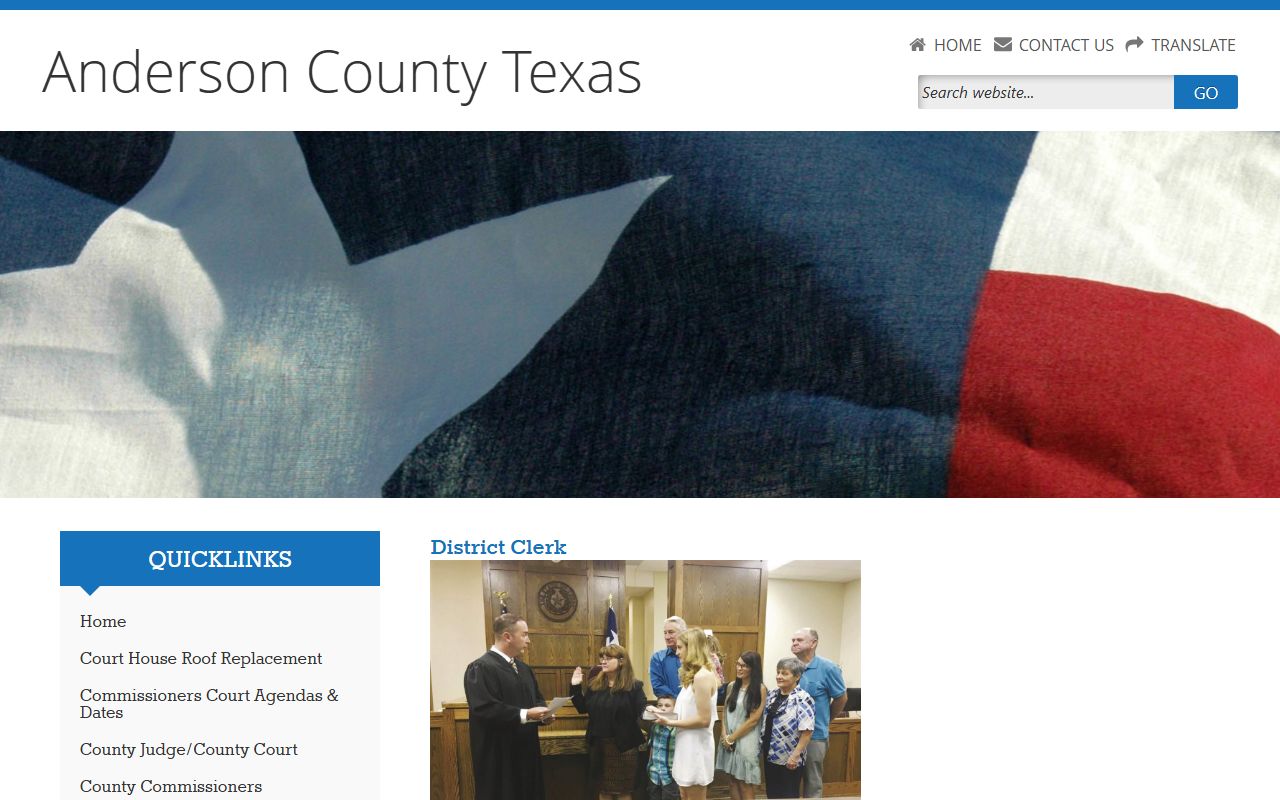
From the District Clerk page, you can find links to online search tools, filing fee schedules, and contact information for the family law deputy.
Anderson County Divorce Filing Process
Filing for divorce in Anderson County follows Texas Family Code Chapter 6. To file here, at least one spouse must have lived in Texas for six months and in Anderson County for at least 90 days before filing. That rule comes from Texas Family Code § 6.301.
Most divorces in Anderson County use the no-fault ground of insupportability under Texas Family Code § 6.001. That means the marriage has broken down due to conflict or discord with no real chance of fixing things. You do not have to prove the other party did something wrong to use this ground. Fault-based grounds are also available, including cruelty, adultery, felony conviction, and abandonment, but they are used less often.
When you file, you submit an Original Petition for Divorce and a BVS 165 form, which is required by Texas Health and Safety Code § 192.009. The other party must be served with citation, or they can sign a Waiver of Service. After that, Texas requires a 60-day waiting period before the divorce can be finalized under Texas Family Code § 6.702. If both spouses agree on all terms, the case can move quickly once the waiting period ends. Contested cases may take longer and may go to mediation or trial.
Anderson County has four district courts that handle divorce cases: the 3rd, 87th, 349th, and 369th District Courts. All are located at the same address in the courthouse. There is also a County Court at Law on the 10th floor of the courthouse. Property division follows Texas Family Code Chapter 7, which requires the court to divide community property in a just and right manner.
The Anderson County homepage at co.anderson.tx.us provides links to all county offices, including the District Clerk's family law division that handles divorce records.

The county website links to court calendars, fee schedules, and the online portal for searching divorce cases filed in Palestine.
What Anderson County Divorce Records Contain
An Anderson County divorce record is a set of documents filed in a district court case. The file starts with the Original Petition for Divorce, which lists the grounds and what the filing party is asking for. From there, the record may grow to include responses, motions, temporary orders, and agreements. When the judge signs the Final Decree of Divorce, that document goes into the file as well. The clerk keeps all of it.
The Final Decree of Divorce is the key document most people need. It spells out the full terms: who gets what property, how debts are split, custody and visitation arrangements, child support amounts, and any spousal maintenance. Certified copies of the decree are needed for legal name changes, Social Security updates, pension transfers, or proving marital status. The clerk can make certified copies for you at $1.00 per page plus $5.00 for the certification stamp.
Anderson County divorce records typically include: case number and parties' names, filing date and final decree date, grounds for divorce, property and debt division, child custody and possession schedules, child support orders, and any protective orders or restraining orders entered in the case. Most of these documents are public record. Financial exhibits like tax returns may be sealed. Records about children may be restricted in some situations.
Divorce Fees in Anderson County
Anderson County charges standard Texas district court filing fees to open a divorce case. Filing fees vary based on whether children are involved and whether citation must be issued. Expect to pay roughly $300 to $400 to file. Check with the clerk's office for the current fee schedule, since fees can change.
Additional costs may come up during the case. Service of citation by the sheriff or a private process server is separate from the filing fee. Certified copies of the decree cost $1.00 per page plus a $5.00 certification fee. If your case involves children, you may also need to complete a parenting class. Fees for that vary by provider.
If you cannot afford to pay court costs, you can ask the court to waive fees. You file a Statement of Inability to Afford Payment of Court Costs under Texas Rule of Civil Procedure 145. You must show proof that payment would be a hardship. Forms for this are on the state court website at txcourts.gov. The judge decides whether to grant the waiver.
Note: Anderson County no longer accepts checks as of January 1, 2020. Bring a debit card, credit card, money order, or cash when you visit the clerk's office.
The Texas Court Records search tool at texascourtrecords.us provides a case index for Anderson County divorce and court records.
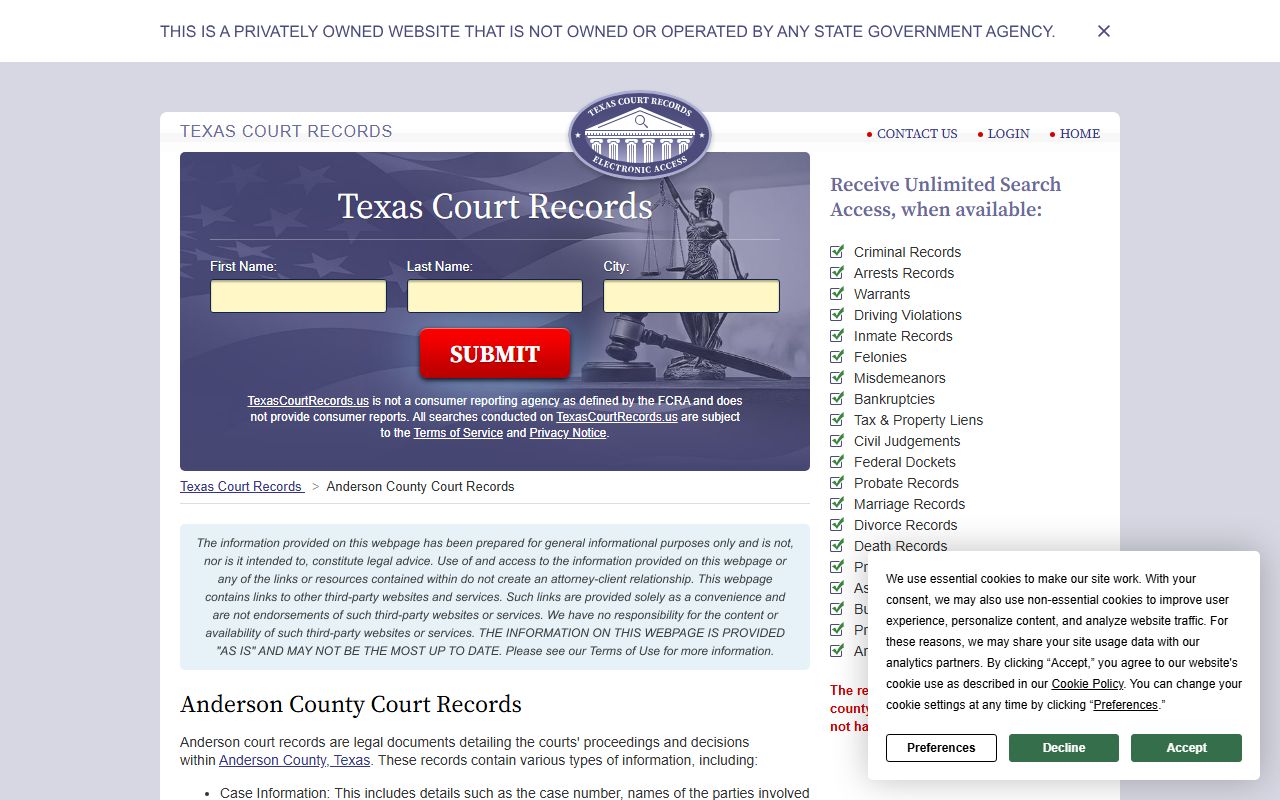
This third-party index can help you find case numbers and party names before you contact the District Clerk's office for certified copies.
Legal Help in Anderson County
If you need help with a divorce in Anderson County, several free and low-cost resources are available. The District Clerk's staff can tell you how to file and what forms to use, but they cannot give legal advice. For legal guidance, look to the resources below.
TexasLawHelp.org is the best starting point for people handling their own divorce. The site has step-by-step guides, all the official court forms, and plain-language explanations of Texas divorce law. Official court forms are also available directly from txcourts.gov. Both sites are free.
The State Bar of Texas runs a lawyer referral service at texasbar.com that can connect you with a local family law attorney. Legal aid organizations serve low-income residents in East Texas. Call (800) 252-9690 to ask about eligibility. The Texas Attorney General's Child Support Division at texasattorneygeneral.gov helps with child support enforcement if that is an issue in your case.
Cities in Anderson County
Palestine is the county seat and the main city in Anderson County. All divorce cases filed in the county go through the District Clerk's office at the Anderson County Courthouse in Palestine.
Other communities in Anderson County include Frankston, Elkhart, Westwood, and Neches. None of these cities have a separate filing office. All divorce matters go through the Anderson County District Clerk in Palestine.
Nearby Counties
Anderson County borders several other Texas counties. If you are not sure which county handles your divorce, the rule is simple: file where you have lived for at least 90 days. The counties below neighbor Anderson County and each has its own District Clerk.