
Armstrong County Divorce Records
Armstrong County divorce records are held by the District Clerk in Claude, Texas. If you need to find a divorce case or get a certified copy of a final decree in Armstrong County, the District Clerk handles all district court records. Armstrong County is one of the smallest counties in Texas by population, with about 1,900 residents. The District Clerk and County Clerk roles are combined and held by one person in this county, so one office handles both sets of records. You can contact the clerk by phone, email, or in person during business hours.
Armstrong County Overview
Armstrong County District Clerk
Tawnee Blodgett serves as both the District Clerk and the County Clerk for Armstrong County. The combined office is located at 100 Trice Street, Claude, TX 79019. The mailing address is P.O. Box 309, Claude, TX 79019. The phone number is (806) 553-2861 and the fax is (806) 553-5981. Email inquiries can be sent to tawnee.blodgett@co.armstrong.tx.us. The office keeps all district court case files, including divorce records going back to 1898.
Armstrong County has unusual office hours. The office is open Monday through Thursday from 8:00 AM to 6:00 PM, including the lunch hour. The office is closed on Fridays. If you need to visit or call outside of those hours, special appointments may be available. This is a small rural county, so the clerk is often the best and only direct contact for any records request. E-filing is available for civil and family law cases through efile.txcourts.gov.
| Office | Armstrong County District/County Clerk |
|---|---|
| Address |
100 Trice Street Claude, TX 79019 |
| Mailing Address | P.O. Box 309, Claude, TX 79019 |
| Phone | (806) 553-2861 |
| tawnee.blodgett@co.armstrong.tx.us | |
| Hours | Monday through Thursday, 8:00 AM to 6:00 PM (closed Fridays) |
| Website | co.armstrong.tx.us |
The Armstrong County District Clerk page at co.armstrong.tx.us provides contact information, office hours, and resources for requesting Armstrong County divorce records.
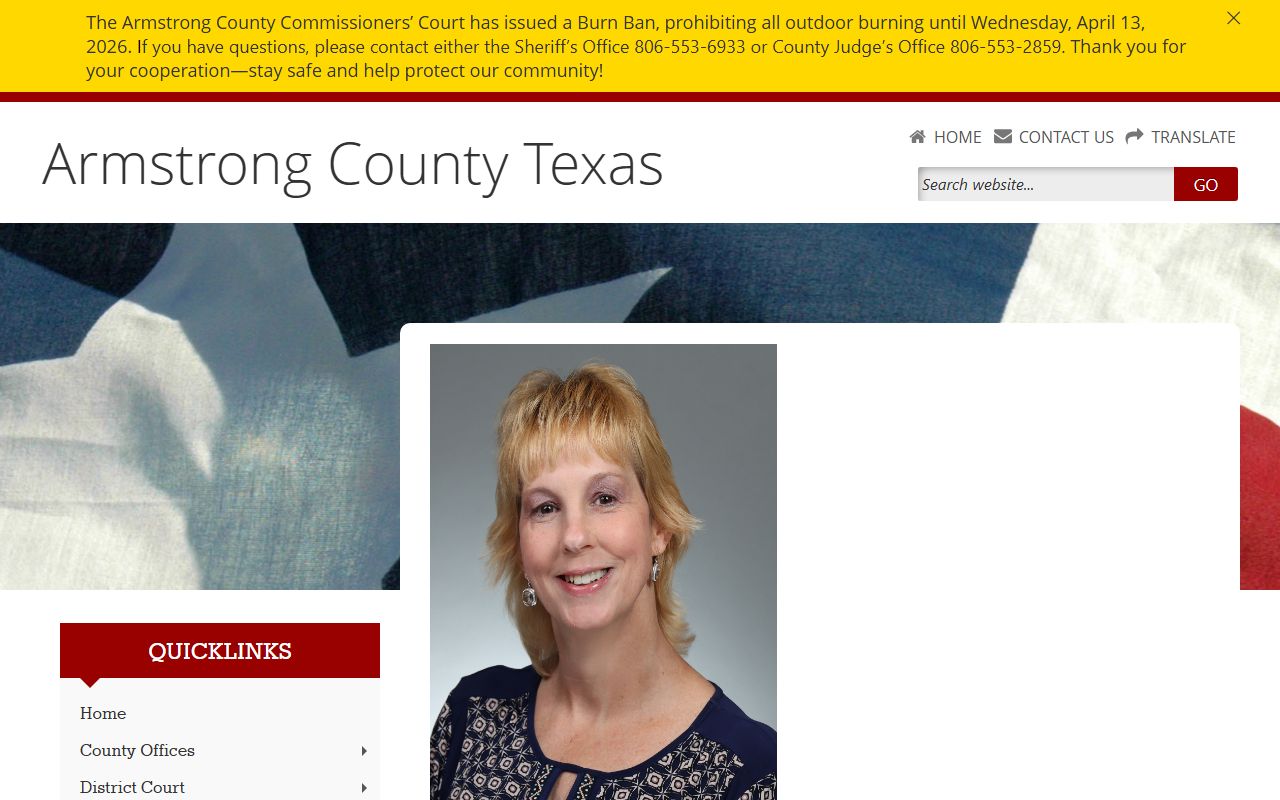
Note the unusual hours: the office is open Monday through Thursday until 6:00 PM but is closed on Fridays. Plan your visit or call accordingly.
Searching Armstrong County Divorce Records
Armstrong County is small and its online records access is limited compared to larger Texas counties. The best way to search Armstrong County divorce records is to contact the District Clerk directly. You can call (806) 553-2861 or email tawnee.blodgett@co.armstrong.tx.us to ask about a specific case. Have party names and the approximate year of the divorce ready. If you have a cause number, that makes the search faster.
TexasFile provides a searchable index for Armstrong County records from 2017 to 2025. Free registration is required to search by name. This tool works best for more recent records. For older cases from the 1800s and early 1900s, the District Clerk's physical records are the primary source. The statewide re:SearchTX portal may also include some Armstrong County cases in its database.
For a basic confirmation that a divorce was recorded in Texas, the DSHS Vital Statistics office at dshs.texas.gov maintains a statewide divorce index from 1968 onward and can issue verification letters. This is faster than requesting from the county if you only need proof that a divorce occurred, not the full decree.
In-person visits to the courthouse at 100 Trice Street in Claude let you review files directly and request copies. Payment methods accepted include check, money order, and cash. Contact the office for current copy fees, as Armstrong County does not publish a detailed fee schedule online. Standard Texas copy fees of $1.00 per page with a $5.00 certification fee per document are common across the state.
Divorce Filing in Armstrong County
Divorces in Armstrong County follow Texas state law like every other county. Under Texas Family Code § 6.301, one spouse must have lived in Texas for six months and in Armstrong County for at least 90 days before filing. Given the county's small population, most residents who divorce here have strong ties to Claude and the surrounding area. You file the Original Petition for Divorce at the District Clerk's office on Trice Street.
Texas Family Code § 6.001 sets out insupportability as the no-fault ground for divorce. This is the most common option and means you do not have to prove the other spouse did anything wrong. You simply state that the marriage cannot be saved. Fault grounds such as cruelty, adultery, and abandonment are also available under Texas law but are used less frequently.
After filing and completing service, there is a mandatory 60-day waiting period under Texas Family Code § 6.702 before the court can grant the divorce. In a small county like Armstrong, uncontested cases often move quickly once the 60 days pass. If both parties agree on all terms, the process is straightforward. Contested cases may require hearings before the judge. Property division follows Texas Family Code Chapter 7 using community property principles. The court splits what was earned or acquired during the marriage in a just and right manner. Gifts, inheritances, and pre-marriage property stay separate.
The Armstrong County homepage at co.armstrong.tx.us provides access to county office information and links to the combined District/County Clerk's office that handles Armstrong County divorce records.

The county site includes jury notifications and contact information for all county offices, including the District Clerk's combined office in Claude.
What Armstrong County Divorce Records Contain
Armstrong County divorce records are the official case files kept at the courthouse in Claude. Each file contains the documents submitted throughout the case. The Original Petition for Divorce starts the file. The file grows to include any responses, motions, temporary orders, and agreements filed during the case. The Final Decree of Divorce, signed by the judge, is the last and most important document in the file. It ends the marriage and sets all final terms.
The decree covers property division, how debts are handled, custody and visitation if children are involved, child support, and any spousal maintenance. Certified copies of the decree are needed for name changes, financial account updates, and legal matters that require proof of divorce. You can get certified copies from the District Clerk at 100 Trice Street during business hours.
Armstrong County divorce records typically contain: parties' names and case number, filing date and final decree date, grounds for divorce, property settlement terms, child custody and support orders, and any protective orders in the case. These records are public. Sensitive financial exhibits like tax returns may be sealed by court order. Records about minor children may have restricted access in certain situations.
Legal Help in Armstrong County
Armstrong County is a small rural county with limited local legal services. The District Clerk cannot give legal advice. For help understanding the divorce process, use the free online resources below.
TexasLawHelp.org offers step-by-step divorce guides and free court forms in English and Spanish. The Texas Supreme Court-approved forms cover divorces with and without children and are available at txcourts.gov. For legal representation, the State Bar of Texas lawyer referral service at texasbar.com can help you find a family law attorney in the Panhandle region. Amarillo attorneys often serve Armstrong County and surrounding Panhandle communities. Child support matters can be handled through the Texas Attorney General at texasattorneygeneral.gov.
Cities in Armstrong County
Claude is the county seat and the only incorporated city in Armstrong County. All divorce filings in the county go through the District Clerk's office at 100 Trice Street in Claude.
Armstrong County is a rural Panhandle county with a very small population. There are no other qualifying cities. The nearby city of Amarillo in Potter and Randall counties has its own District Clerk offices for residents of those counties.
Nearby Counties
Armstrong County is in the Texas Panhandle. These counties border Armstrong County and handle divorces for their own residents.