
Bailey County Divorce Records
Bailey County divorce records are maintained by the District Clerk in Muleshoe. If you need to find a divorce case, get a certified copy of a decree, or look up a filing in Bailey County, the District Clerk's office at 300 South 1st Street in Muleshoe is where you go. Bailey County is a small Panhandle county on the Texas-New Mexico border. All district court records, including divorce filings, are kept in the clerk's office. You can request records by phone, in person, or by mail. This page explains how to find and access Bailey County divorce records.
Bailey County Overview
Bailey County District Clerk
District Clerk Lupita Pineda manages the Bailey County District Clerk's office at 300 South 1st Street, Suite 130, Muleshoe, TX 79347. The phone number is (806) 272-3165 and the fax is (806) 272-3124. Deputy Clerk Jamie Pilman also works in the office. Contact information for the deputy is available through the county website. The clerk's office handles all district court records, including divorce petitions, orders, decrees, and case files. Staff can search by party name or case number and make copies upon request.
Bailey County is a small rural county in the Texas South Plains. The District Clerk's office may have limited hours compared to larger counties. Call ahead at (806) 272-3165 to confirm current business hours and to ask about fees before you visit or send a mail request. E-filing is available through efile.txcourts.gov for attorneys filing civil and family law cases in Bailey County.
| Office | Bailey County District Clerk |
|---|---|
| Address |
300 South 1st Street, Suite 130 Muleshoe, TX 79347 |
| Phone | (806) 272-3165 |
| Fax | (806) 272-3124 |
| Website | co.bailey.tx.us |
The Bailey County District Clerk page at co.bailey.tx.us provides contact information and office details for the clerk's office in Muleshoe that handles Bailey County divorce records.
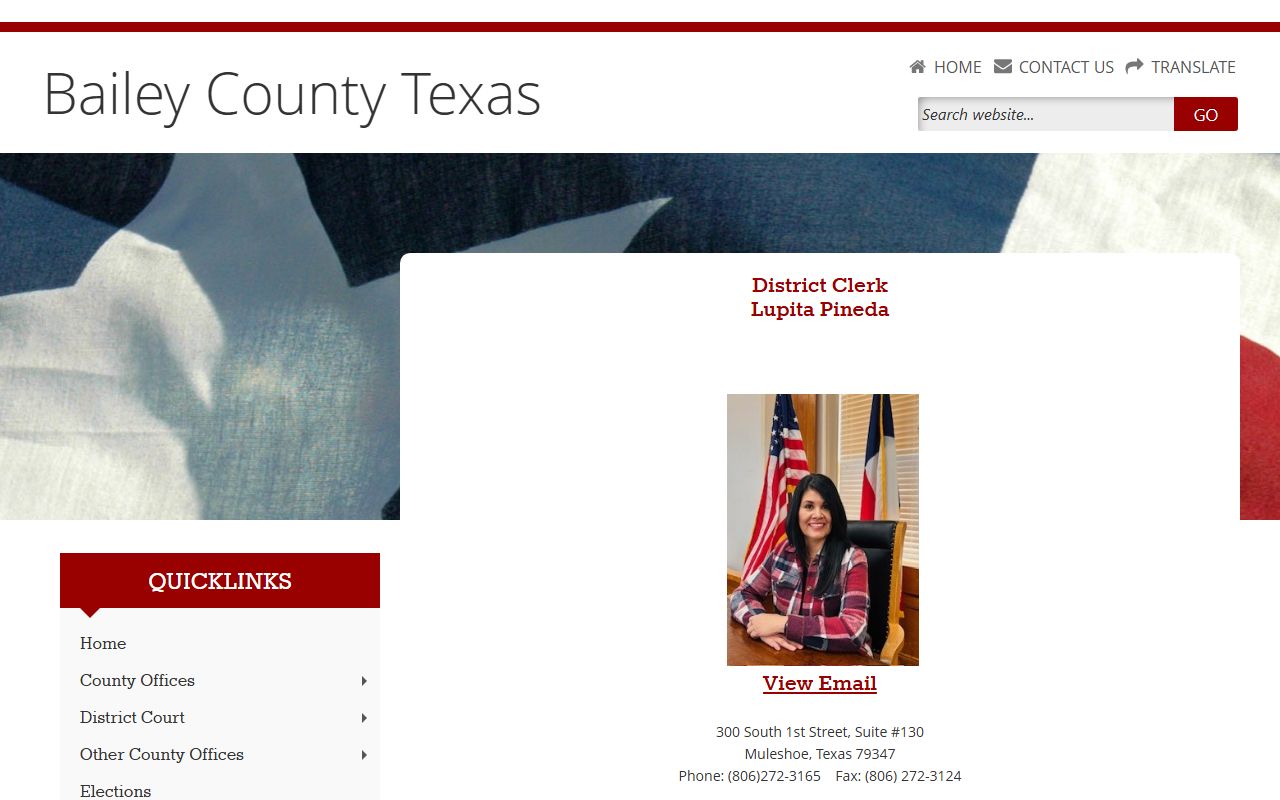
Call (806) 272-3165 before visiting to confirm office hours and fees, since Bailey County is a small rural county with limited staff.
How to Search Bailey County Divorce Records
The most direct way to search Bailey County divorce records is to contact the District Clerk at (806) 272-3165. The clerk can search by party name or case number and tell you whether a divorce was filed in Bailey County. In-person visits to Suite 130 at 300 South 1st Street in Muleshoe let you review the full case file and order copies the same day.
For online searches, the statewide re:SearchTX system provides access to district court case indexes across Texas, including Bailey County. You can search by name or cause number to get basic case information. For certified copies of the final decree, you still need to contact the District Clerk directly. The co.bailey.tx.us county website may also have links to public records access tools.
Mail requests go to 300 South 1st Street, Suite 130, Muleshoe, TX 79347. Include party names and the approximate year of the divorce. Ask the clerk by phone to confirm the copy fee and how to submit payment before you mail your request. Standard fees in Texas are $1.00 per page for copies and $5.00 per document for certification. Bailey County follows those same general standards, but call ahead to confirm the current amounts.
For a quick divorce verification rather than the full case file, the Texas DSHS Vital Statistics office at dshs.texas.gov issues verification letters for Texas divorces from 1968 onward. VitalChek at vitalchek.com can also help order vital records verification online through state-authorized channels.
Divorce Filing Process in Bailey County
Filing for divorce in Bailey County follows the same Texas state law that applies in every county. Under Texas Family Code § 6.301, one spouse must have lived in Texas for six months and in Bailey County for at least 90 days before filing. You file the Original Petition for Divorce at the District Clerk's office in Muleshoe. Get your forms first from TexasLawHelp.org or txcourts.gov, since the clerk's office does not provide them.
Most Bailey County divorces use the no-fault ground of insupportability under Texas Family Code § 6.001. This means you are saying the marriage is broken beyond repair due to conflict or discord. No proof of wrongdoing is needed. Fault grounds like cruelty, adultery, and abandonment are also valid under Texas law if you want to claim them, but they are harder to prove and less commonly used.
After filing and completing service, a mandatory 60-day waiting period applies under Texas Family Code § 6.702. The judge cannot sign the final decree until the 60 days are up. In a small county like Bailey, uncontested cases often move quickly after that. Property division follows Texas Family Code Chapter 7. Texas is a community property state, and the court splits marital property in a just and right manner. Separate property stays with its original owner.
If children are involved, the Final Decree of Divorce will include custody and support terms under Texas Family Code Chapter 153. The decree sets out the conservatorship arrangement, the possession schedule, and the child support obligation. All of this becomes part of the official Bailey County divorce record on file at the courthouse.
What Bailey County Divorce Records Contain
Bailey County divorce records are the official case files held at the District Clerk's office in Muleshoe. Each file starts with the Original Petition for Divorce and ends with the Final Decree signed by the judge. In between, the file may contain the respondent's answer, service documents, motions, temporary orders, and agreements reached during the case.
The Final Decree of Divorce is the document people need most. It ends the marriage and spells out all the terms: property division, debt allocation, custody, possession schedule, child support, and any spousal maintenance. You need a certified copy to prove the divorce happened and to handle legal and financial matters after it. The clerk can make certified copies for the standard per-page fee plus the certification charge.
Bailey County divorce records typically include both parties' names, case number, filing date, final decree date, grounds for divorce, property division terms, custody and support arrangements, and court costs. These records are public in most cases. Some financial documents may be sealed. Records about minor children may have restricted access in certain situations. Very old records may be stored differently than recent ones, so contact the clerk's office for anything filed more than a decade ago.
The Bailey County homepage at co.bailey.tx.us links to all county offices, including the District Clerk's office in Muleshoe that maintains divorce case files for Bailey County residents.
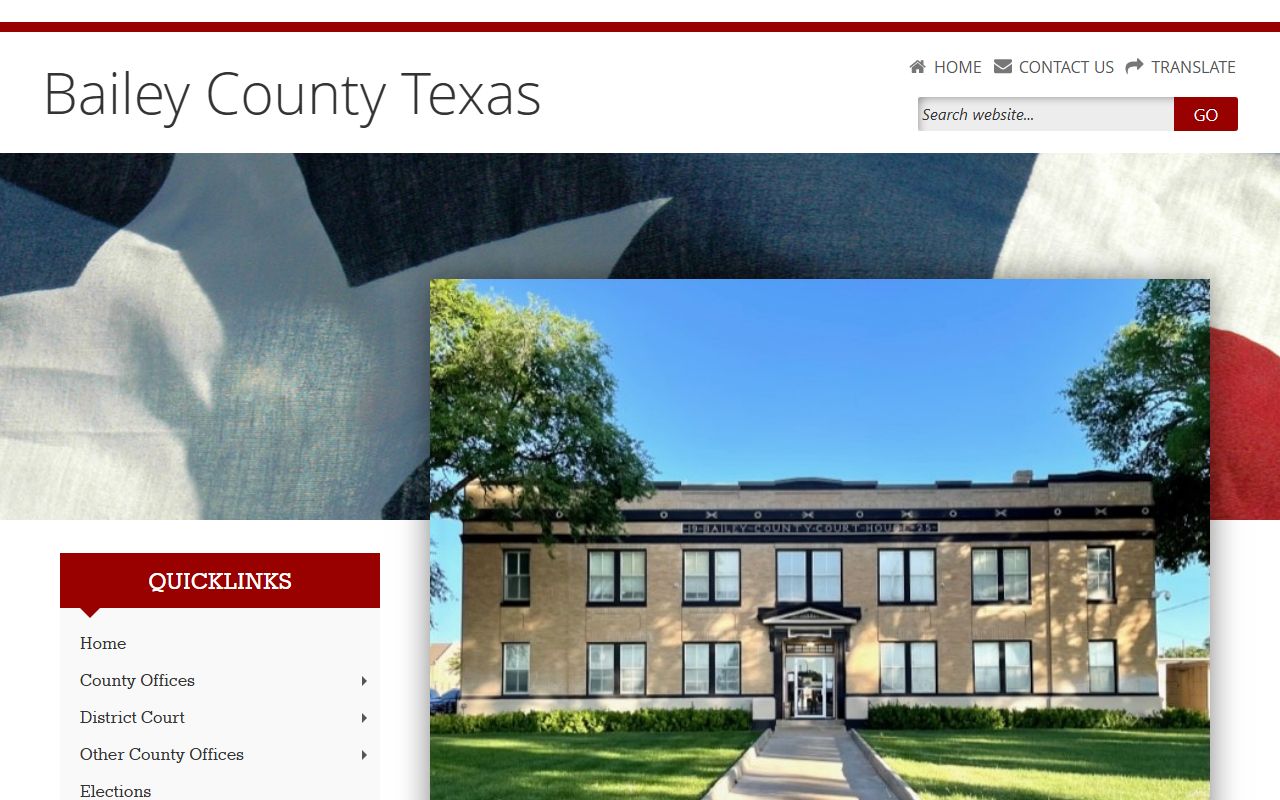
The county site provides contact information and links for requesting divorce records and other district court documents from the Bailey County clerk's office.
Legal Help in Bailey County
The District Clerk in Muleshoe cannot give legal advice on your case. For free guidance, TexasLawHelp.org has step-by-step divorce guides and all the official court forms you need. The site covers both divorces with children and without, and guides for agreed and contested cases. Court forms are also at txcourts.gov at no cost.
To find a family law attorney in the South Plains area, use the State Bar of Texas lawyer referral tool at texasbar.com. Lubbock-area attorneys often serve Bailey County and nearby Panhandle counties. Legal aid organizations serving West Texas may also help low-income residents with Bailey County divorce cases. The Texas Attorney General at texasattorneygeneral.gov handles child support matters. Texas courts at txcourts.gov has general information about the court system statewide.
Cities in Bailey County
Muleshoe is the county seat and only incorporated city in Bailey County. All divorce filings in the county go through the District Clerk's office at 300 South 1st Street in Muleshoe.
Bailey County has no other qualifying cities. The nearest large city is Lubbock in Lubbock County, which has its own separate District Clerk and court system.
Nearby Counties
Bailey County sits in the Texas South Plains near the New Mexico state line. These counties border Bailey County and each handles divorces for their own residents.