
Find Divorce Records in Baylor County
Baylor County divorce records are on file at the District Clerk's office in Seymour. The clerk handles all family law case filings and stores the complete records for every divorce granted in the county. You can search by party name or by the case number if you already have it. Requests can be made in person, by phone, or by mail.
Baylor County Overview
Baylor County District Clerk Office
The District Clerk in Baylor County is Chris Jakubicek. This office serves the 50th Judicial District and handles both district and county clerk duties in a combined role. That means the same office that manages district court records also handles county-level clerk services. Divorce records fall under the district clerk side of the office.
Chris Jakubicek's office is located at 101 S. Washington Street in Seymour, which is the county seat of Baylor County. The office keeps the full case file for every divorce filed in the county's district court. This includes the original petition, all court orders, any agreements signed by the parties, and the Final Decree of Divorce.
You can reach the office by phone at (940) 889-3322 or by fax at (940) 889-4300. The website at co.baylor.tx.us has a contact form you can use as well. Written requests sent to the office should include the names of both parties and the approximate year the divorce was filed.
| Office | Baylor County District and County Clerk |
|---|---|
| District Clerk | Chris Jakubicek |
| Address | 101 S. Washington Street, Seymour, TX 76380 |
| Phone | (940) 889-3322 |
| Fax | (940) 889-4300 |
| Website | co.baylor.tx.us - District Clerk |
The District Clerk's page at co.baylor.tx.us lists contact details for Chris Jakubicek's office and a contact form for making requests.
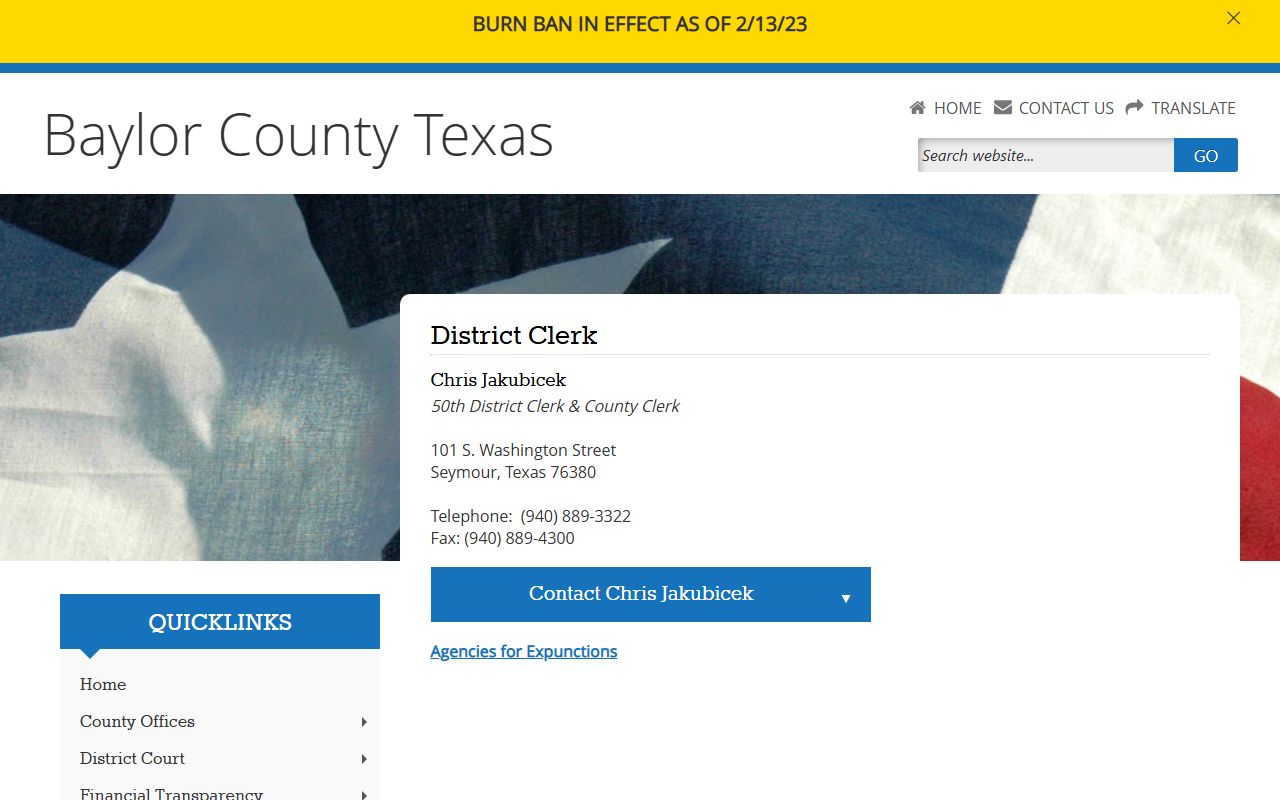
This page confirms the office location, phone numbers, and services available from the combined District and County Clerk office in Seymour.
You can also start with the main county website at co.baylor.tx.us to find links to various county offices and services.
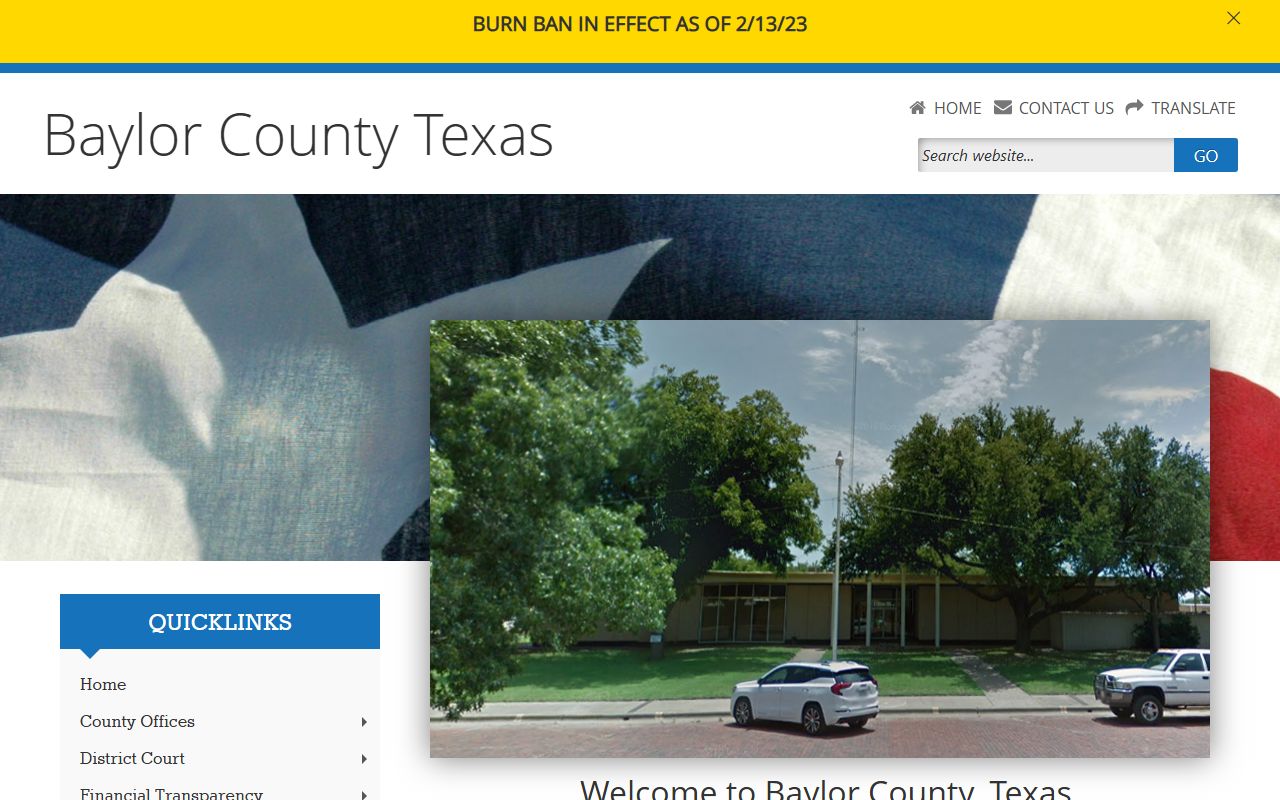
The main site links to departments including the clerk's office, and you can navigate from there to find what you need.
How to Get Baylor County Divorce Records
To get a copy of a divorce record from Baylor County, you have three main options. You can visit the clerk's office in person at 101 S. Washington Street in Seymour. You can call at (940) 889-3322 and ask for guidance. Or you can write to the office and submit a request by mail.
When you contact the clerk, give as much detail as you can. The full names of both parties help staff find the case quickly. The approximate year of the divorce makes the search easier. If you have the cause number from a prior search, include that too. The clerk can search by party name even without a case number.
The statewide re:SearchTX court portal may also show case information for Baylor County filings. This free online system lets you look up cases by name. If the case appears, you can see docket entries and the cause number, which you can then use when contacting the clerk to request documents.
Certified copies of the Final Decree of Divorce come with an official certification from the clerk. These are used for legal purposes. Plain copies cost less but are not certified. The clerk can tell you the current fee for each type when you call or visit.
Divorce Filing in Baylor County
Filing for divorce in Baylor County requires that at least one spouse has lived in Texas for six months and in Baylor County for 90 days before filing. Texas Family Code § 6.301 sets this residency rule. You file the Original Petition for Divorce with the District Clerk's office in Seymour.
Texas is a no-fault divorce state. Under Texas Family Code § 6.001, a marriage may be dissolved on the ground of insupportability when the marriage has become unsalvageable due to conflict between the parties. This is the most common reason cited in Texas divorce petitions and does not require proving any wrongdoing.
After the petition is filed, Texas law requires a 60-day waiting period before the court can finalize a divorce. This rule is in Texas Family Code § 6.702. If the case involves children, additional steps apply. A parenting plan and possibly a parenting class may be required before the judge will sign the final order.
Texas follows community property rules under Texas Family Code Chapter 7. Property acquired during the marriage is generally considered marital property and is subject to division. The court divides it in a way that is just and right. Separate property, meaning items owned before the marriage or received as gifts or inheritance, stays with the original owner if properly documented.
Official divorce forms are available through the Texas court system. You can download forms at txcourts.gov. The Texas Supreme Court approves these forms for use by people representing themselves.
Contents of a Baylor County Divorce Record
Each divorce case file at the Baylor County District Clerk's office has multiple documents. The core document is the Final Decree of Divorce. This is the signed court order that ends the marriage. It lists the names of both parties, the date the decree was signed, and all the terms the judge approved.
The decree spells out who gets what property, including real estate, personal items, vehicles, and financial accounts. If children are involved, it also includes a conservatorship arrangement and a possession schedule. Child support amounts are in the decree if ordered. Spousal maintenance terms appear there too, if any were awarded.
The full case file may also include the original petition, any answers filed by the responding spouse, motions for temporary orders, financial statements, and correspondence with the court. Most of these materials are public records unless sealed by the judge. Sensitive items like detailed financial documents may have restricted access.
The state-level divorce index is maintained by the Texas DSHS Vital Statistics section. That index goes back to 1968 and shows basic facts such as the parties' names, the county, and the year. For anything beyond those basics, you need to contact the Baylor County District Clerk directly.
Help with Divorce in Baylor County
Baylor County is a rural area, but residents still have access to statewide legal resources. If you need help with a divorce case, the following options may be useful.
TexasLawHelp.org has free self-help guides, FAQs, and links to court forms for divorce cases. The site is designed for people who represent themselves. It explains the steps in plain language and covers issues like property division, child custody, and how to request records.
The State Bar of Texas can connect you with a licensed attorney. Use the referral service at texasbar.com. You can search by county or practice area. Most initial consultations are low cost. If you cannot afford a lawyer, ask about legal aid options when you call.
For self-filers, the Texas court system provides standardized divorce forms at txcourts.gov. These forms are reviewed by the Texas Supreme Court and cover common divorce situations. Instructions are included with each packet. Electronic filing is also available through eFileTexas SelfHelp for people without an attorney.
Nearby Counties
Baylor County is in north central Texas. The counties around it also maintain their own divorce records. If you think a case may have been filed elsewhere, check the county where the parties lived at the time.