
Cottle County Divorce Records
Divorce records in Cottle County are kept by the District Clerk in Paducah, the county seat. If you need to find a divorce case, request a copy of a decree, or confirm a past filing, you contact that office directly. This is a small rural county in northwest Texas, and records go back many decades. The District Clerk handles all filings and copies for cases heard in the local district court. Most records are public and can be pulled by name or case number. For older cases not in a digital system, you may need to call ahead to allow time for retrieval.
Cottle County Overview
Cottle County District Clerk
The District Clerk in Paducah is the official keeper of all divorce case records filed in Cottle County. That office processes new filings, stores case documents, and responds to records requests. Staff can search by name or cause number and pull copies from the file. The courthouse is in downtown Paducah.
Cottle County is part of the 50th Judicial District. The same judge handles cases across several counties in this part of the state. Because the county is small, the court does not sit every week. If you have an active case, check with the District Clerk's office on scheduled court dates. The office can direct you to the judge's schedule and let you know when hearings are set.
The county website at co.cottle.tx.us lists county offices and provides a link to the District Clerk section. You can also access the District Clerk page directly at co.cottle.tx.us/page/cottle.District.Clerk.
| Office | Cottle County District Clerk |
|---|---|
| Address |
Cottle County Courthouse Paducah, TX 79248 |
| Judicial District | 50th Judicial District |
| Hours | Monday through Friday, 8:00 AM to 5:00 PM |
| Website | co.cottle.tx.us/page/cottle.District.Clerk |
How to Find Cottle County Divorce Records
The most direct way to search Cottle County divorce records is to call or visit the District Clerk's office. This is a small county and records may not all be in a statewide database. Calling first saves you time and lets the staff prepare any file before you arrive. For recent cases, you may also try the re:SearchTX statewide portal.
The Cottle County website uses an ezTaskTitanium content system. The District Clerk and District Court sections are under the main menu. The office can search by party name or by cause number. For older cases from before digital records, files may be in physical storage and need extra time to retrieve.
You can search by the full name of either spouse. If you have the year of filing or the cause number, that helps narrow the results faster. Certified copies cost more than plain copies. Contact the office for current copy fees before you visit.
The county website homepage at co.cottle.tx.us also posts public notices and financial transparency documents. That is where you find current burn ban status, commissioners' court agendas, and other county news.
The Cottle County website provides contact information for all county offices including the District Clerk.
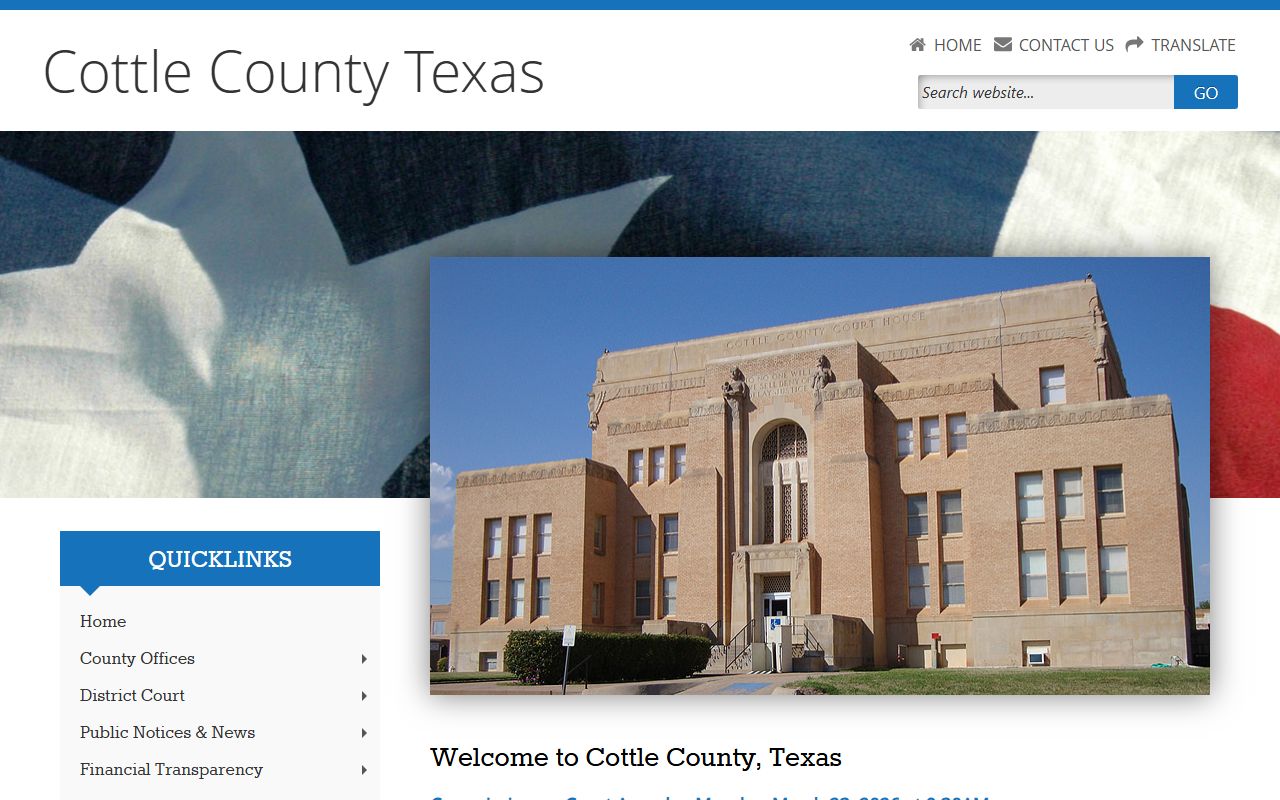
The county homepage lists office contacts and navigation to the District Court section where divorce filings are managed.
The Cottle County District Clerk page is where you find direct information about accessing court records.
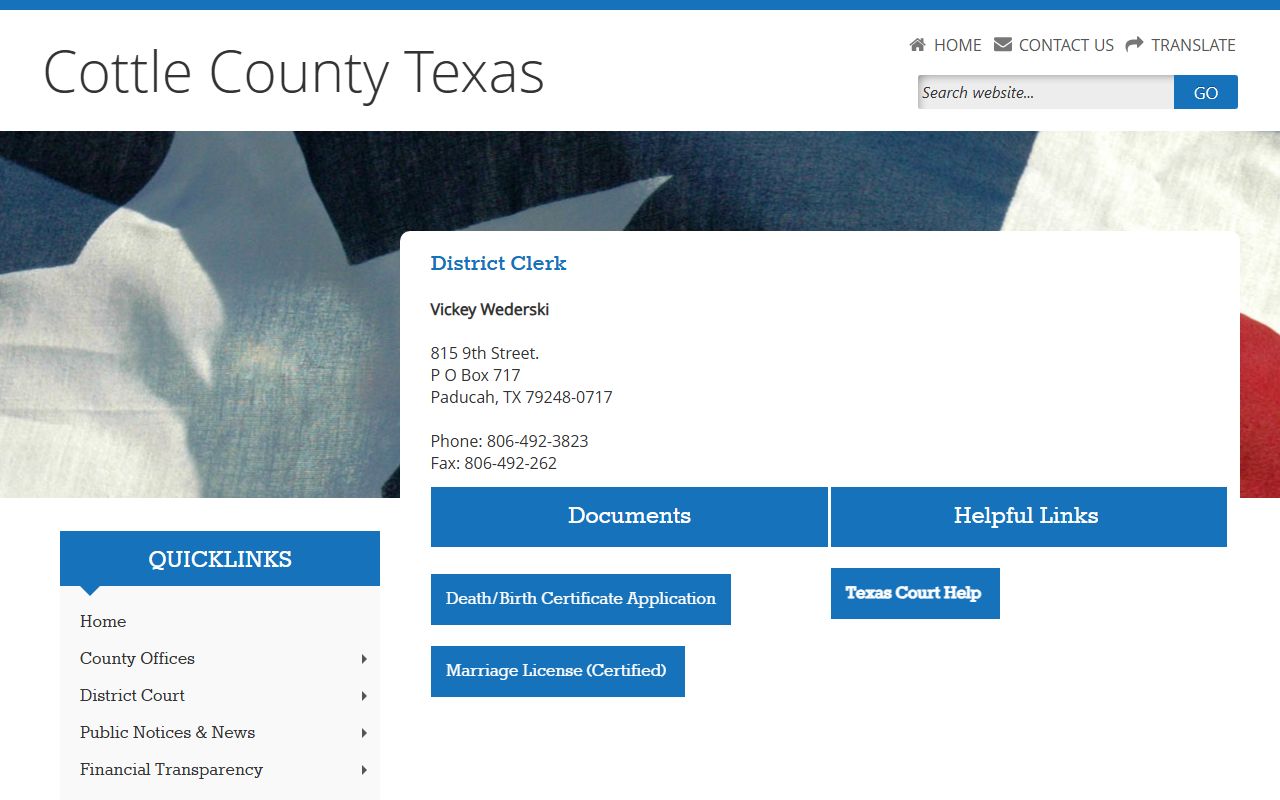
The District Clerk page is the starting point for any request involving divorce case files or certified copies in Cottle County.
Filing for Divorce in Cottle County
To file for divorce in Cottle County, at least one spouse must have lived in Texas for six months and in Cottle County for 90 days before filing. This is the residency requirement under Texas Family Code Section 6.301. If you do not meet this, you file in the county where you do live.
Texas allows no-fault divorce. The most common ground is insupportability under Texas Family Code Section 6.001, which means the marriage cannot continue due to conflict with no chance of fixing things. Most uncontested cases in Cottle County use this ground. Fault grounds like cruelty, adultery, and abandonment are also available when they apply.
Once you file the Original Petition for Divorce, the other spouse must be served. After service, a 60-day waiting period begins before any judge can sign a final decree. This rule comes from Texas Family Code Section 6.702. The wait can be skipped in cases that involve family violence.
If both spouses agree on all terms, the case is uncontested and can be wrapped up once the 60 days pass. Disputed cases may need hearings or a trial. The judge in the 50th Judicial District handles Cottle County cases along with other counties in the district, so scheduling can take time. Plan ahead if your case is contested.
Texas is a community property state. Property division follows Texas Family Code Chapter 7, and the court splits marital property in a way that is just and right. Separate property kept apart from marital funds stays with the original owner.
Note: Fee waivers are available for people who cannot afford to pay court costs. Ask the District Clerk for a Statement of Inability to Afford Payment of Court Costs form under Texas Rule of Civil Procedure 145.
What Cottle County Divorce Records Include
A divorce case file in Cottle County holds all documents filed with the court. The Original Petition starts the file. After that, service of process papers, any agreements or orders, and the Final Decree of Divorce all go in. Parenting plans and child support orders are part of the file when children are involved. Most of these documents are public and available on request.
The Final Decree of Divorce is the core document. It says the marriage is over and spells out all the terms. That includes how property is divided, who has custody, what the possession schedule looks like, and any support amounts. You need a certified copy of the decree if you want to change your name, prove your marital status, or show the decree to another court or agency.
A divorce record typically includes:
- Names of both spouses and their addresses at filing
- Date of marriage and county where married
- Grounds cited for divorce
- Property and debt division terms
- Child conservatorship and possession schedule if applicable
- Child support and spousal maintenance if ordered
- Name change order if requested
Some parts of a divorce file may be sealed. Tax returns and other financial records attached as exhibits are sometimes restricted. Info about children can be limited in certain cases. The District Clerk can tell you what is publicly available and what needs a court order to access.
For a basic divorce verification, the Texas Department of State Health Services Vital Statistics Section keeps a statewide index going back to 1968. That index is at dshs.texas.gov/vital-statistics/marriage-divorce-verification. It confirms a divorce happened but does not give you the full decree. For the actual document, you go to the District Clerk.
Legal Help for Divorce in Cottle County
People in Cottle County can get legal help through a few different channels. The State Bar of Texas runs a lawyer referral service you can reach at (800) 252-9690 or search at texasbar.com. Many family law attorneys offer a first consultation at low or no cost.
If you cannot afford a lawyer, Texas RioGrande Legal Aid and Lone Star Legal Aid both serve parts of rural Texas. Eligibility is based on income. TexasLawHelp at texaslawhelp.org has self-help guides and free court forms. Official court forms are also at txcourts.gov/rules-forms. These include Supreme Court approved divorce forms for cases with and without children.
The Texas Vital Statistics Section handles statewide divorce verification requests. Reach them at dshs.texas.gov/vital-statistics. For a full divorce decree, contact the Cottle County District Clerk directly.
Note: Court forms and self-help guides at texaslawhelp.org are available in both English and Spanish and cover most common divorce situations in Texas.
Cities in Cottle County
Paducah is the county seat and the largest community in Cottle County. All divorce filings for the county go through the District Clerk's office there.
Other communities in Cottle County include Chalk, Roberta, and Swearingen. None of these have their own district courts. All divorce cases in the county are handled at the Cottle County Courthouse in Paducah.
Nearby Counties
Cottle County borders several other counties in this part of northwest Texas. If you are not sure which county to file in, check where you have lived for the past 90 days.