
Access Atascosa County Divorce Records
Atascosa County divorce records go back to 1857 and are held by the District Clerk in Jourdanton. If you need to find a divorce case, get a certified copy of a decree, or look up a filing in Atascosa County, the District Clerk's office at the courthouse on Courthouse Circle is where you go. Atascosa County is south of San Antonio and has been issuing divorces since 1857. You can request records in person or by contacting the clerk by phone. This page covers the key facts about finding and obtaining Atascosa County divorce records.
Atascosa County Overview
Atascosa County District Clerk
The Atascosa County District Clerk's office handles all divorce records for the county. The main office is at #1 Courthouse Circle, Suite 102, Jourdanton, TX 78026. The main county phone number is (830) 767-2511. An alternate number for the District Clerk, listed in the Texas Divorce Online directory, is (830) 769-3011. Contact the office to confirm current hours and any fee information before you visit or send a request.
Atascosa County divorce records date back to 1857, making the county's records one of the longer-running in South Texas. Court records from 1857 to 1910 are also maintained by the District Clerk, along with naturalization records from 1888 to 1903. For very old records, contact the clerk's office in advance to confirm retrieval times, as older files may require advance notice if stored off-site or on microfilm.
| Office | Atascosa County District Clerk |
|---|---|
| Address |
#1 Courthouse Circle, Suite 102 Jourdanton, TX 78026 |
| Phone | (830) 767-2511 |
| Alternate Phone | (830) 769-3011 |
| Website | atascosacounty.texas.gov |
| State Records Portal | re:SearchTX |
The Atascosa County homepage at atascosacounty.texas.gov provides links to all county offices, including the District Clerk's office that maintains divorce records dating back to 1857.
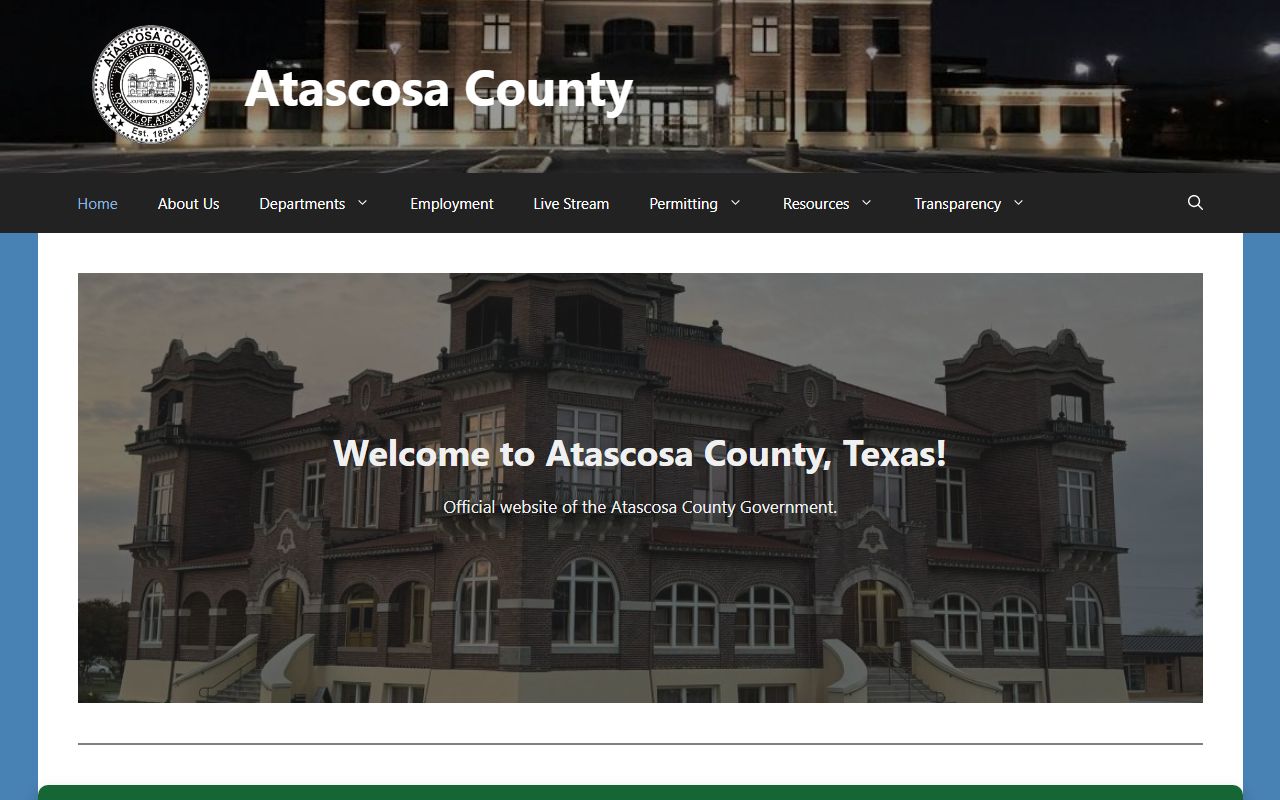
From the county site, you can find links to the District Clerk's department, court schedules, and contact information for the Jourdanton courthouse.
How to Search Atascosa County Divorce Records
The statewide re:SearchTX portal is a good starting point for Atascosa County divorce records. You can search by party name or cause number and get basic docket information and case status for district court cases. For full case documents or certified copies, you need to contact the District Clerk directly at (830) 767-2511 or visit the courthouse in Jourdanton.
In-person requests at Suite 102 on Courthouse Circle let you review the full case file and order copies the same day. Bring a valid photo ID and any details you have about the case. Party names and the approximate year of the divorce are enough for a basic search. A cause number makes things faster. Staff can search the records and let you know what documents are available and what the copies will cost.
Written requests by mail are also accepted. Include the names of both parties, the approximate date of the divorce, and any case number you have. Include payment or ask about payment instructions in advance. Standard Texas copy fees are $1.00 per page. Certified copies require an additional $5.00 per document for the certification. Atascosa County divorce records are generally public. Most people can request them without needing to explain why they need them.
For a basic divorce confirmation rather than the full file, the Texas DSHS Vital Statistics Section at dshs.texas.gov issues verification letters for Atascosa County divorces from 1968 forward. These letters confirm the divorce happened but do not include decree details. They are useful for insurance claims, Social Security matters, and immigration paperwork.
Atascosa County Divorce Filing Process
To file for divorce in Atascosa County, at least one spouse must have lived in Texas for six months and in Atascosa County for 90 days before filing. That requirement comes from Texas Family Code § 6.301. If you meet those requirements, go to the District Clerk's office at Suite 102 on Courthouse Circle in Jourdanton and file the Original Petition for Divorce. You also file the required BVS 165 form per Texas Health and Safety Code § 192.009 at the same time.
Texas Family Code § 6.001 allows divorce on the no-fault ground of insupportability. This is the most used option. You state that the marriage has broken down because of conflict or personality differences and cannot be repaired. Fault grounds like cruelty and adultery remain available but need to be proven in court. Most Atascosa County divorce cases use the no-fault ground.
Once the petition is filed and the other spouse is served or waives service, a 60-day waiting period begins under Texas Family Code § 6.702. The judge cannot sign the decree until that window closes. After that, an agreed divorce can be wrapped up quickly. Contested divorces may need mediation or a hearing. Atascosa County is near San Antonio in Bexar County, but it has its own court system. Do not confuse Atascosa County filings with Bexar County cases.
Property division in Atascosa County divorces follows Texas Family Code Chapter 7. Texas is a community property state. The court divides what was earned or acquired during the marriage in a just and right manner. Anything each spouse owned before the marriage, or received as a gift or inheritance, is separate property and stays with that spouse. Child custody and support terms follow Texas Family Code Chapter 153 and are included in the Final Decree.
What Atascosa County Divorce Records Contain
Atascosa County divorce records are the full case files maintained by the District Clerk. Each file starts with the Original Petition for Divorce and ends with the judge-signed Final Decree. In between, the file may include the respondent's answer, service documents, motions, temporary orders, mediation agreements, and financial disclosures. All of these are kept together as the official case record.
The Final Decree is the document that most people need. It ends the marriage, divides property and debts, sets custody and visitation terms, orders child support, and may include spousal maintenance. You need a certified copy to handle legal and financial matters after divorce, including name changes, pension transfers, and changes to Social Security records. The District Clerk issues certified copies for the standard fee.
An Atascosa County divorce record typically includes: both parties' full names, dates of marriage and final decree, case number, grounds for divorce, property and debt division, conservatorship and support arrangements for children, and court costs. Most of these records are public. Financial documents like tax returns may be sealed. Child-related information may have limited access under court order.
Legal Help in Atascosa County
The District Clerk's office in Jourdanton cannot give legal advice. They can tell you what to file and what it costs, but guidance on the law itself must come from an attorney or a legal aid resource. TexasLawHelp.org is the best free resource for self-represented parties. The site has guides for every divorce situation, all official court forms, and plain-English explanations of Texas family law.
To find a family law attorney serving Atascosa County, use the State Bar of Texas lawyer referral tool at texasbar.com. Many attorneys from San Antonio also handle cases in Atascosa County. Legal aid organizations in South Texas may help low-income residents. The Texas Attorney General's office at texasattorneygeneral.gov handles child support matters. Official court forms are free at txcourts.gov. E-filing for attorneys is through efile.txcourts.gov.
Cities in Atascosa County
Jourdanton is the county seat of Atascosa County. All divorce cases for county residents are filed at the Atascosa County District Clerk's office at Courthouse Circle in Jourdanton.
Other communities in Atascosa County include Pleasanton, Poteet, Charlotte, and Lytle. None of these cities have a separate district clerk. All divorce matters go through the Atascosa County courthouse in Jourdanton. Nearby San Antonio is in Bexar County and has its own separate court system.
Nearby Counties
Atascosa County borders several South Texas counties. File your divorce case in the county where you have lived for at least 90 days.