
Delta County Divorce Records Search
Delta County divorce records are maintained by the District Clerk in Cooper, the county seat. The office stores all case files from the district court and handles requests for copies of divorce decrees and other documents. Delta County is a small rural county in Northeast Texas, east of the Dallas-Fort Worth area. If you need to look up a divorce case or get a certified copy of a final decree, the District Clerk in Cooper is the right place to contact. Staff can search by name or cause number and assist with your request.
Delta County Overview
Delta County District Clerk
The District Clerk in Cooper holds all divorce records for Delta County. The clerk handles filings, stores case documents, and responds to copy requests. Staff can search by party name or cause number. The Delta County Courthouse is in Cooper, and the clerk's office is part of the courthouse complex.
The county website at deltacountytx.com features several county services including a Veterans Service Office that assists veterans and their dependents. The site also notes that 911 addressing services are managed by ATCOG (Ark-Tex Council of Governments). County cleanup events and road and bridge information are also listed. For District Clerk contact info specifically, navigate to the appropriate county office section of the website.
Delta County is a small county with straightforward operations. If the website does not have the specific phone or email for the District Clerk, calling the main courthouse number and asking to be transferred is the fastest option. The clerk's office handles a manageable caseload, so staff can often help you while you wait.
| Office | Delta County District Clerk |
|---|---|
| Address |
Delta County Courthouse 200 W Dallas Ave Cooper, TX 75432 |
| Judicial District | 8th Judicial District |
| Hours | Monday through Friday, 8:00 AM to 5:00 PM |
| Website | deltacountytx.com |
How to Search Delta County Divorce Records
The simplest way to find a Delta County divorce record is to call or visit the courthouse in Cooper. Give the clerk the full name of at least one spouse, the approximate year the divorce was filed or granted, and a cause number if you have one. The office can search by any of these identifiers and will let you know what is in the file.
For recent cases, the re:SearchTX statewide court portal is a free option worth trying first. It covers courts across Texas, though smaller counties may not have complete older records in the system. If the portal does not return results, contact the clerk directly. The clerk can also confirm current fees for copies before you make the trip to Cooper.
The Delta County website provides information about county services and how to reach county offices.
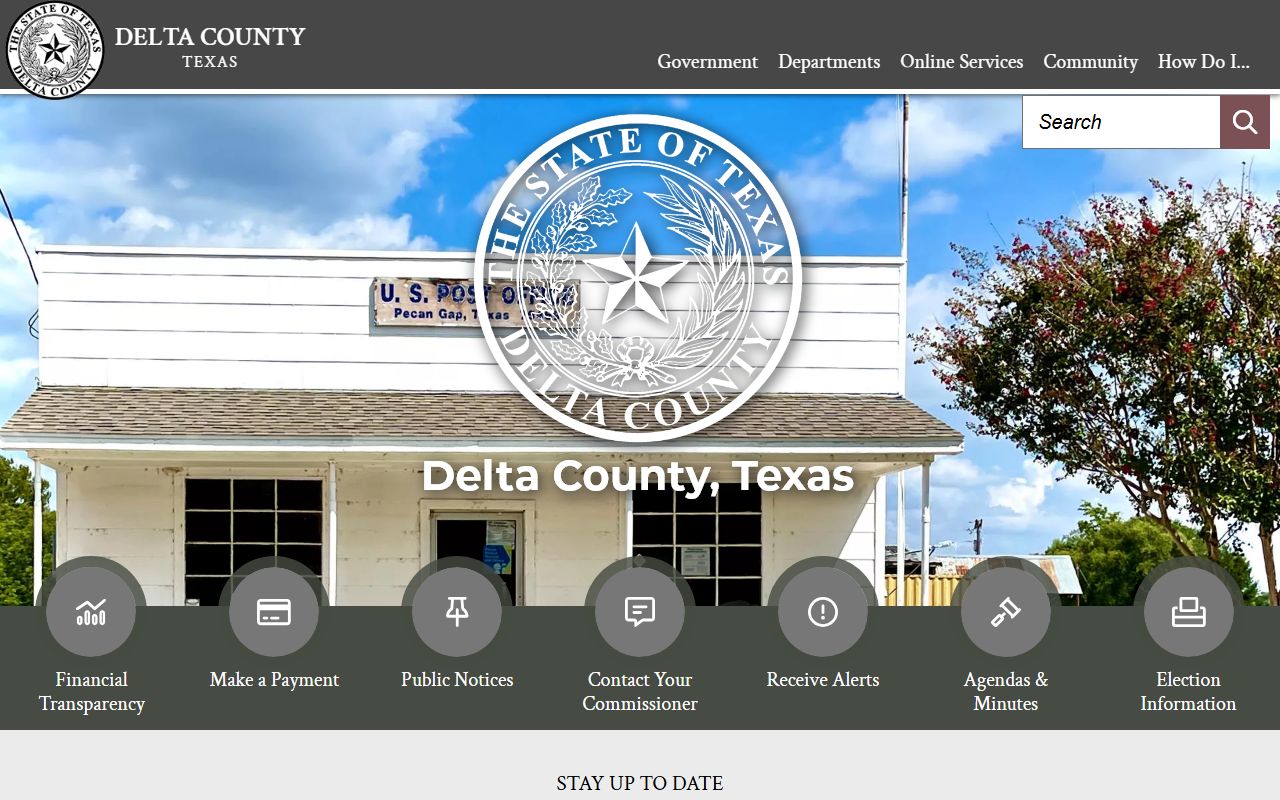
The Delta County homepage at deltacountytx.com is the starting point for finding county office contacts, including the District Clerk who handles divorce filings and record requests.
For a basic Texas divorce verification, the DSHS Vital Statistics Section at dshs.texas.gov/vital-statistics/marriage-divorce-verification keeps a statewide index from 1968 to present. That shows names, county, and date. For the actual decree, contact the Delta County District Clerk.
Filing for Divorce in Delta County
Texas law under Texas Family Code Section 6.301 requires one spouse to have lived in Texas for six months and in Delta County for 90 days before filing. If neither spouse has lived in the county that long, file in the Texas county where one of you meets the 90-day requirement. Delta County is a good place to file if you live in or near Cooper.
Texas allows divorce on no-fault grounds under Texas Family Code Section 6.001. The ground is called insupportability, and it means the marriage has broken down because of conflict or personality differences that cannot be fixed. This is the standard ground used in most uncontested divorces. If fault matters to your case, Texas also recognizes cruelty, adultery, felony conviction, abandonment after one year, living apart for three or more years, and mental hospital confinement for three or more years as grounds for divorce.
After you file, the other spouse must be served with the petition and a citation. From that point, a 60-day waiting period begins under Texas Family Code Section 6.702. No judge can grant the divorce until the 60 days have passed. In cases involving family violence, the court can skip the wait. Once the waiting period ends, uncontested cases can move to a final hearing quickly. Contested cases take longer and often require mediation or a trial before the judge.
Texas is a community property state. Delta County divorces follow Texas Family Code Chapter 7 for property division. The court splits marital property in a way that is just and right. What you owned before the marriage or got by gift or inheritance stays yours as long as it was kept separate from shared marital property. Land and farm property may need careful documentation to show what is separate versus community.
Note: If you cannot pay court costs, ask the clerk about a Statement of Inability to Afford Payment under Texas Rule of Civil Procedure 145. The court reviews your financial situation and decides if you qualify for a waiver.
What Is in a Delta County Divorce Record
A divorce case file at the Delta County District Clerk's office contains everything filed during the proceeding. It opens with the Original Petition for Divorce and grows with service records, responses, agreements, temporary orders, and the Final Decree of Divorce. Financial affidavits and parenting plans go into the file when the case involves property or children.
The Final Decree of Divorce is the core document. It ends the marriage and records every order the court made. Property division and debt assignment are in there, along with any custody and possession arrangements for children, child support amounts, and spousal maintenance if ordered. If a name change was part of the agreement, the decree reflects that too. A certified copy of the decree is needed to legally change your name or prove your marital status to other agencies.
Most items in the file are public records. Financial exhibits attached to the case may be sealed in some situations. Records involving minor children may have restricted access. The clerk can explain what is publicly available and what requires a specific request or court order before you make a trip to Cooper. Copy fees are set by the clerk's office and can be confirmed by phone.
Legal Help for Delta County Divorce Cases
The State Bar of Texas referral service at (800) 252-9690 and at texasbar.com can help you find a family law attorney who works in Northeast Texas. Attorneys in Paris, Greenville, and other nearby cities often take cases in smaller surrounding counties. Many offer reduced-fee consultations and flat-rate fees for uncomplicated divorce cases.
If cost is a barrier, TexasLawHelp at texaslawhelp.org provides free self-help guides and court forms for Texas divorce cases. Official Supreme Court approved forms are also at txcourts.gov/rules-forms. Lone Star Legal Aid serves Northeast Texas and may be able to help with your case at no cost if your income qualifies. The county also maintains a Veterans Service Office that can direct veterans to legal resources specific to their situation.
Note: Delta County has a Veterans Service Office that assists veterans and their dependents. Veterans dealing with divorce issues may be able to get a referral to legal aid services through that office.
Cities in Delta County
Cooper is the county seat and the primary city in Delta County. All divorce filings and record requests for the county go through the District Clerk's office in Cooper.
Ben Franklin and Lake Creek are small communities also in Delta County. Neither has a separate district court. All family law matters, including divorce cases, are handled at the Delta County Courthouse in Cooper.
Nearby Counties
Delta County is in Northeast Texas between the DFW metro area and the state's eastern border. These counties are close to Delta County.