
Ellis County Divorce Records
Ellis County divorce records are held by the District Clerk in Waxahachie. The office keeps all divorce filings, case documents, and final decrees for cases filed in this county. You can request copies in person at the courthouse or search for basic case information online through the statewide court records portal. Ellis County sits just south of Dallas and handles a steady volume of family law cases each year. Whether you need to confirm a prior divorce or get a certified copy of a decree, the District Clerk is the right place to start. The office also handles records from Waxahachie and surrounding communities, including the portion of Mansfield that falls within Ellis County.
Ellis County Overview
Ellis County District Clerk
The District Clerk in Waxahachie is the official keeper of all divorce records in Ellis County. Every petition, judgment, and final decree filed in the district court goes into the clerk's files. If you need to find a case or get a copy of a divorce record, this is the office to contact. Staff can look up cases by name or cause number and make copies for a fee.
Ellis County is part of the 40th Judicial District. The courthouse sits in downtown Waxahachie on the historic square. Family law cases, including divorce, are filed and heard in the district courts. The county is in the Dallas-Fort Worth metro area, and its proximity to Dallas means the volume of filings is higher than in many rural Texas counties.
The Ellis County website at co.ellis.tx.us has contact information and links to county departments. The District Clerk page is at co.ellis.tx.us/320/District-Clerk.
| Office | Ellis County District Clerk |
|---|---|
| Address |
Ellis County Courthouse 109 S. Jackson Street Waxahachie, TX 75165 |
| Phone | (972) 825-5091 |
| Hours | Monday through Friday, 8:00 AM to 5:00 PM |
| Website | co.ellis.tx.us/320/District-Clerk |
The Ellis County homepage screenshot below shows the official county website, which links to all department offices including the District Clerk.
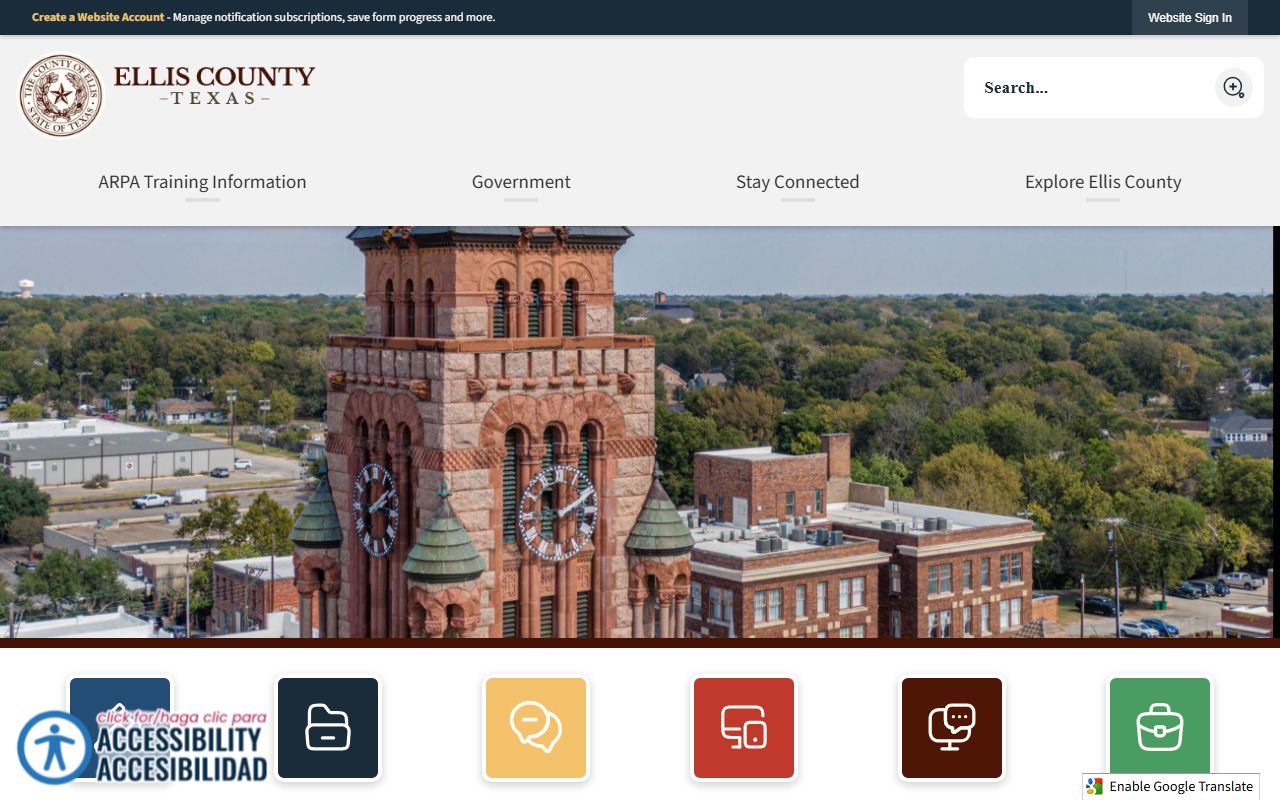
From the main county site you can navigate to the District Clerk to find contact details and records request information.
How to Search Ellis County Divorce Records
You have two main options for searching divorce records in Ellis County. The first is the statewide re:SearchTX portal, which covers many Texas counties. You can look up cases by party name or cause number. It shows docket entries, filing dates, and case status. The second option is to go in person to the District Clerk's office in Waxahachie, where staff can pull case files and make copies.
To get the best results, have the full name of at least one spouse and an approximate year the case was filed. A cause number speeds things up even more. If the case is old, records may be stored off-site and may take extra time to retrieve. For certified copies of a final decree, in-person visits are often faster than mail requests.
The Texas Department of State Health Services at dshs.texas.gov/vital-statistics also keeps a divorce index from 1968 to present. That index has basic info only: names, county, and date. It is not the actual decree.
Note: The re:SearchTX system is a good first step, but not all older Ellis County cases appear there. Call the District Clerk to confirm availability before making a trip.
Filing a Divorce in Ellis County
Divorce filings in Ellis County go through the District Clerk's office. Filing fees cover the petition, citation, and court costs. The exact amount depends on the type of case. Divorces without children run lower than cases involving kids. Fees also vary based on whether you need service by constable or private process server.
People who cannot pay court costs may qualify for a fee waiver under Texas Rule of Civil Procedure 145. You file a Statement of Inability to Afford Payment of Court Costs and show proof of financial hardship. The court decides if you qualify. Official court forms, including the fee waiver, are posted at txcourts.gov/rules-forms/forms.
Electronic filing is required for attorneys in Texas. Self-represented litigants can also e-file through the Texas eFile portal. If you prefer to file in person, bring all required documents to the District Clerk's office during business hours.
Divorce Process in Ellis County
Texas divorce law applies across all counties, including Ellis. The process starts with filing an Original Petition for Divorce with the District Clerk. You or your spouse must meet the residency requirement under Texas Family Code section 6.301: at least one person must have lived in Texas for six months and in Ellis County for 90 days before filing.
Most people file on no-fault grounds. Texas Family Code section 6.001 allows divorce based on insupportability, which means the marriage has broken down with no chance of reconciliation. No one has to prove fault for the divorce to move forward. Fault-based grounds like cruelty, adultery, or felony conviction are also available under Chapter 6 if the situation calls for it.
After filing, there is a mandatory 60-day waiting period before the court can grant a divorce. This comes from Texas Family Code section 6.702. Exceptions exist when family violence is involved. Once the waiting period passes, a judge can sign the Final Decree of Divorce if both sides agree or if the court rules after a hearing.
60-Day Waiting Period: Texas law requires you wait at least 60 days after filing before the court can grant a divorce. Ellis County follows this rule for all cases unless a family violence exception applies.
Property division in Texas follows community property rules under Texas Family Code Chapter 7. Assets and debts acquired during the marriage are split in a way the court finds just and right. What each spouse owned before the marriage is generally kept separate.
What Ellis County Divorce Records Show
A divorce case file at the Ellis County District Clerk includes multiple documents. The petition starts the case and states the grounds. The citation is served on the other spouse. Financial affidavits, property inventories, and parenting plans may all be part of the file. The Final Decree of Divorce is the order that ends the marriage and sets all the terms.
Most divorce records in Ellis County are public. Anyone can request copies. You do not need to be a party to the case. However, financial documents like tax returns or exhibits filed under seal are not open to the public. Records involving minor children may have limited access in some situations.
A typical divorce record in Ellis County includes:
- Names of both parties and the date of marriage
- Grounds for divorce
- Property and debt division terms
- Child conservatorship and possession orders
- Child support and spousal maintenance amounts
- Signature of the district court judge
Certified copies of the Final Decree cost more than plain copies. You will need a certified copy to change your name on government-issued IDs, for remarriage in some states, and for Social Security purposes.
Legal Help for Ellis County Residents
If you need help with a divorce case in Ellis County, several resources are available. Lone Star Legal Aid serves a wide area of Texas and may help people with low income on family law matters. You can reach them at (800) 733-8394 or visit lonestarlegal.org.
The State Bar of Texas lawyer referral service can connect you with an attorney. Call (800) 252-9690 or search at texasbar.com. TexasLawHelp at texaslawhelp.org has free self-help guides for family law cases. Court forms are available at txcourts.gov/rules-forms/forms.
Cities in Ellis County
Ellis County includes Waxahachie and several other communities. Divorce cases for residents throughout the county are filed at the District Clerk in Waxahachie.
Other communities in Ellis County include Ennis, Midlothian, Red Oak, Waxahachie, and Italy. All divorce cases for these areas go through the Ellis County District Court system.
Nearby Counties
These counties border Ellis County. If you are not sure which county handles your case, check the address where you live.