
Tarrant County Divorce Records
Tarrant County divorce records are kept by the District Clerk's office at the courthouse in Fort Worth. You can search cases online, visit in person, or send a written request by mail. The county serves a large population across Fort Worth, Arlington, and dozens of other communities. The District Clerk manages 27 district courts covering family, civil, and criminal matters. If you need to look up a divorce case or get a certified copy of a Final Decree of Divorce, the Tarrant County District Clerk is the office to contact. Both old and recent cases are available through the clerk's case search tools.
Tarrant County Overview
Tarrant County District Clerk
The Tarrant County District Clerk keeps all divorce records filed in the county. This office manages 27 district courts that handle family law, civil, and felony criminal cases. The District Clerk produces civil citations, judgments, and court documents. All divorce case files go through this office, and staff can help you search by name or cause number.
Thomas A. Wilder serves as the District Clerk for Tarrant County. The main office is at 100 N. Calhoun St. in Fort Worth. The clerk's office handles everything from new filings to requests for old records. You can also get copies of court orders, settlement agreements, and Final Decrees of Divorce here. The office offers online case lookup through its public portal, plus in-person and mail options.
| Office | Tarrant County District Clerk |
|---|---|
| Address |
100 N. Calhoun St. Fort Worth, TX 76196 |
| Phone | (817) 884-1574 |
| Family Court Line | (817) 884-1265 |
| Hours | Monday through Friday, 8:00 AM to 5:00 PM |
| Website | tarrantcounty.com/en/district-clerk |
The Tarrant County homepage at tarrantcounty.com also has links to court divisions, public records, and the District Clerk's services. If you need the County Clerk for marriage licenses or property records, that office is at 100 W. Weatherford, Fort Worth, TX 76196, phone (817) 884-1195.
The Tarrant County homepage at tarrantcounty.com provides access to all county departments, including the District Clerk's divorce records portal.
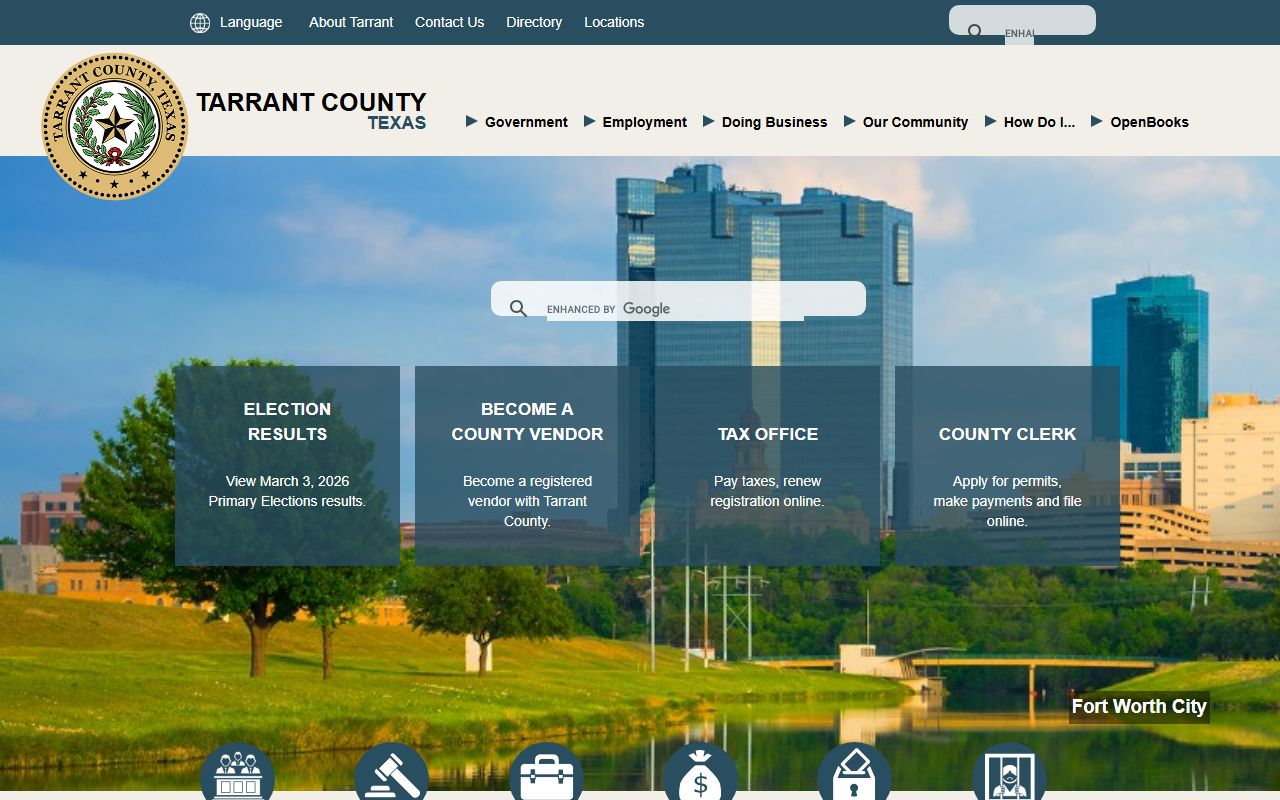
The site links directly to the District Clerk's case search, civil dockets, and self-help legal resources for family law matters.
The Tarrant County District Clerk page at tarrantcounty.com/en/district-clerk shows the specific services available for searching and requesting divorce case files.

From this page you can access civil case lookup, family law dockets, and instructions for requesting certified copies of divorce decrees.
How to Find Tarrant County Divorce Records
You have a few ways to search for divorce records in Tarrant County. Online, in person, and by mail all work. The online portal is the fastest for basic case info. In-person visits let you view the full file and get certified copies on the spot.
The Tarrant County District Clerk runs a public case lookup tool on its website. You can search by party name, cause number, or case type. The system shows docket entries, filing dates, and case status. You can also use the statewide re:SearchTX portal, which covers many Texas counties including Tarrant. Start your search at the District Clerk's site at tarrantcounty.com/en/district-clerk.
To search in person, go to 100 N. Calhoun St. in Fort Worth during business hours. Bring a photo ID. Staff can look up cases for you. You can also request copies of documents at the counter. Certified copies cost more than plain photocopies. Mail requests work too, but they take longer. Send a written request with the full names of both parties, the approximate filing date, and the cause number if you know it. Include payment for copy fees.
Note: Tarrant County also offers a Web Access Account subscription for attorneys and frequent users who need regular access to case files and docket information.
Tarrant County Divorce Filing Fees
The Tarrant County District Clerk charges fees set by state law and the court. Filing a divorce petition runs around $350 for a case without children. Cases with children cost a bit more because of additional required filings and surcharges.
Copy fees at the Tarrant County District Clerk are $1 per page. Certification adds $5 per document. If you do not have the case number and need the clerk to search by name, there is a $5 search fee. These fees apply whether you come in person or send a mail request.
If you cannot pay court costs, you can file a Statement of Inability to Afford Payment of Court Costs under Texas Rule of Civil Procedure 145. You have to show the court that your income or assets are too low to cover fees. Approved forms are available at the courthouse and online at txcourts.gov.
Tip: Fees can change. Confirm current amounts with the District Clerk before you file. Call (817) 884-1574 or check tarrantcounty.com/en/district-clerk.
Filing for Divorce in Tarrant County
Divorce in Tarrant County follows Texas Family Code Chapter 6. Each step in the process creates documents that go into your case file. The District Clerk stores all these records at the courthouse.
To file in Tarrant County, you or your spouse must have lived in Texas for at least six months and in Tarrant County for at least 90 days before filing. This is required under Texas Family Code § 6.301. If you live in Fort Worth, Arlington, or any other Tarrant County community and meet this test, you file here.
Most divorce cases in Tarrant County use the no-fault ground of "insupportability" under Texas Family Code § 6.001. This means the marriage cannot continue because of conflict or discord with no real chance of fixing it. You do not have to prove anyone did something wrong. Fault grounds such as cruelty, adultery, abandonment, and felony conviction are also available when they apply.
The process starts with an Original Petition for Divorce. The other spouse gets served or signs a Waiver of Service. Texas law requires a 60-day waiting period after the petition is filed before a judge can grant the divorce, under Texas Family Code § 6.702. Exceptions apply when there is family violence. Agreed cases move through faster once the waiting period ends. Contested cases may go through mediation or a full trial.
Texas is a community property state. Property division follows Texas Family Code Chapter 7. The court divides marital property in a just and right manner. Community property is what both spouses built up during the marriage. Separate property, like what you had before the marriage or received as a gift, stays with you as long as it was kept separate.
What Is in a Tarrant County Divorce Record
A Tarrant County divorce record includes all the papers filed in the case. The Original Petition for Divorce is the first document. It states who is asking for the divorce, the grounds, and what the petitioner wants. The Final Decree of Divorce is the order that ends the marriage. It spells out all the terms the court approved.
The decree covers property division, who keeps what debts, and all orders about any children. If the case involved children, the record includes a Parenting Plan or order specifying custody, visitation schedules, and child support amounts. If spousal maintenance was ordered, that is in the decree too. Financial affidavits and inventories may be in the file as well.
Most divorce records at the Tarrant County District Clerk are public. You do not need to be a party to the case to request copies. Some financial documents attached to divorce cases may be sealed. Anything that reveals personal financial data submitted under seal stays protected. For most basic requests, the decree itself and the docket sheet are accessible to the public.
Tarrant County uses the Texas eFile system for electronic filing of court documents. Records filed electronically are available through the online case search portal. Older paper records may require an in-person visit or a mail request to get copies.
Legal Help in Tarrant County
Several organizations offer legal help for divorce cases in Tarrant County. Some are free for people who qualify. Others offer reduced-fee consultations. These groups can help you understand your options, fill out forms, or connect you with an attorney.
Lone Star Legal Aid serves Tarrant County and handles family law matters for those with low income. This includes divorce, custody, and child support. Visit lonestarlegal.org for details on eligibility and services. Texas Legal Services Center also provides help at texaslawhelp.org, where you can find self-help guides and official court forms.
The State Bar of Texas runs a lawyer referral service at (800) 252-9690. You can search for attorneys online at texasbar.com. Official Texas divorce forms, approved by the Texas Supreme Court, are available at no cost at txcourts.gov/rules-forms/forms. The Tarrant County District Clerk also has self-help legal resources available on its site.
Cities in Tarrant County
Tarrant County includes several large cities. All of them file divorce cases with the Tarrant County District Court in Fort Worth.
Other communities in Tarrant County include Mansfield, Hurst, Euless, Bedford, Keller, Southlake, Grapevine, and North Richland Hills. All divorce cases for residents of these cities go through the Tarrant County District Court system.
Nearby Counties
These counties border Tarrant County. If you are not sure which county handles your case, check where you live. You must file in the county where one of the spouses has lived for at least 90 days.