
Dallas County Divorce Records
Dallas County divorce records are on file at the District Clerk's office at 600 Commerce Street in downtown Dallas. The office handles all divorce case filings, stores court documents, and provides certified copies of final decrees. Dallas County is the second most populous county in Texas with over 2.6 million residents and covers the city of Dallas plus Irving, Garland, Mesquite, Carrollton, parts of Grand Prairie, and parts of Richardson. If you or your spouse lives in any of these cities, this is the office that handles your divorce. Record requests can be made in person, by mail, or by email.
Dallas County Overview
Dallas County District Clerk
The Dallas County District Clerk maintains all divorce records filed in the county. The office is located in the George L. Allen, Sr. Courts Building in downtown Dallas. A dedicated Records Information Office handles requests for copies of divorce decrees and other case documents. Staff can search by party name or cause number and assist with in-person visits.
Dallas County has multiple family district courts that handle the high volume of divorce and family law cases filed each year. The District Clerk serves only those district courts. It does not maintain records for other Dallas County departments or the City of Dallas. If you filed for divorce in another jurisdiction, that office has your records, not this one.
One important thing to know: Dallas County does not make family court records available online. The county removed family court records from its iDocket subscription service in May 2018 to protect the privacy of children. To get divorce records, you must contact the Records Information Office directly. You can visit in person, send a written request by mail, or email DCRecords@dallascounty.org.
| Office | Dallas County District Clerk - Records Information Office |
|---|---|
| Address |
George L. Allen, Sr. Courts Building 600 Commerce Street, Suite 103 Dallas, TX 75202 |
| Phone | (214) 653-7131 |
| DCRecords@dallascounty.org | |
| Hours | Monday through Friday, 8:00 AM to 5:00 PM |
| Website | dallascounty.org/government/district-clerk |
How to Search Dallas County Divorce Records
Because family court records are not available through the online portal, your options are limited to in-person visits, mail requests, or email. Email requests go to DCRecords@dallascounty.org. For mail, send a written request to the Records Information Office at 600 Commerce Street, Suite 103, Dallas, TX 75202. Include the full names of both parties, approximate year the case was filed, and the cause number if you have it.
To request a divorce decree specifically, Dallas County has a Divorce Decree Request Form available at dallascounty.org/Assets/uploads/docs/district-clerk/Request_DivorceDecree_103116.pdf. Fill out and submit that form with your request to speed up processing. The Records Office can tell you the current fee for copies and how to pay.
For non-family court records, the county does have an online search at dallascounty.org/services/record-search. But divorce and other family court records are excluded from that system. The statewide re:SearchTX portal may also have limited results for Dallas family courts due to the same privacy restrictions.
The Dallas County website is the main hub for county services and information.
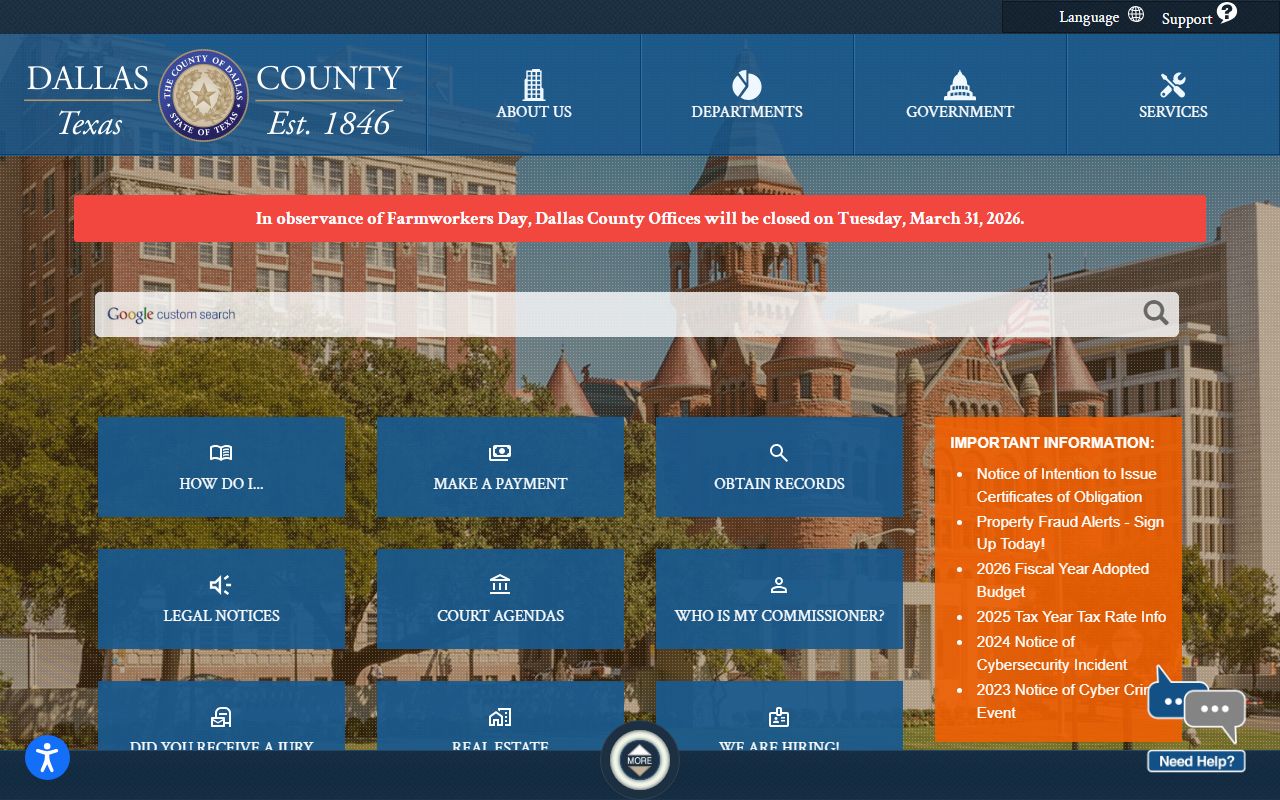
The Dallas County homepage at dallascounty.org links to the District Clerk, the online record search portal, and other county services used for divorce case access.
The Dallas County online record search covers many case types but excludes family court records, which require a direct request to the Records Information Office.
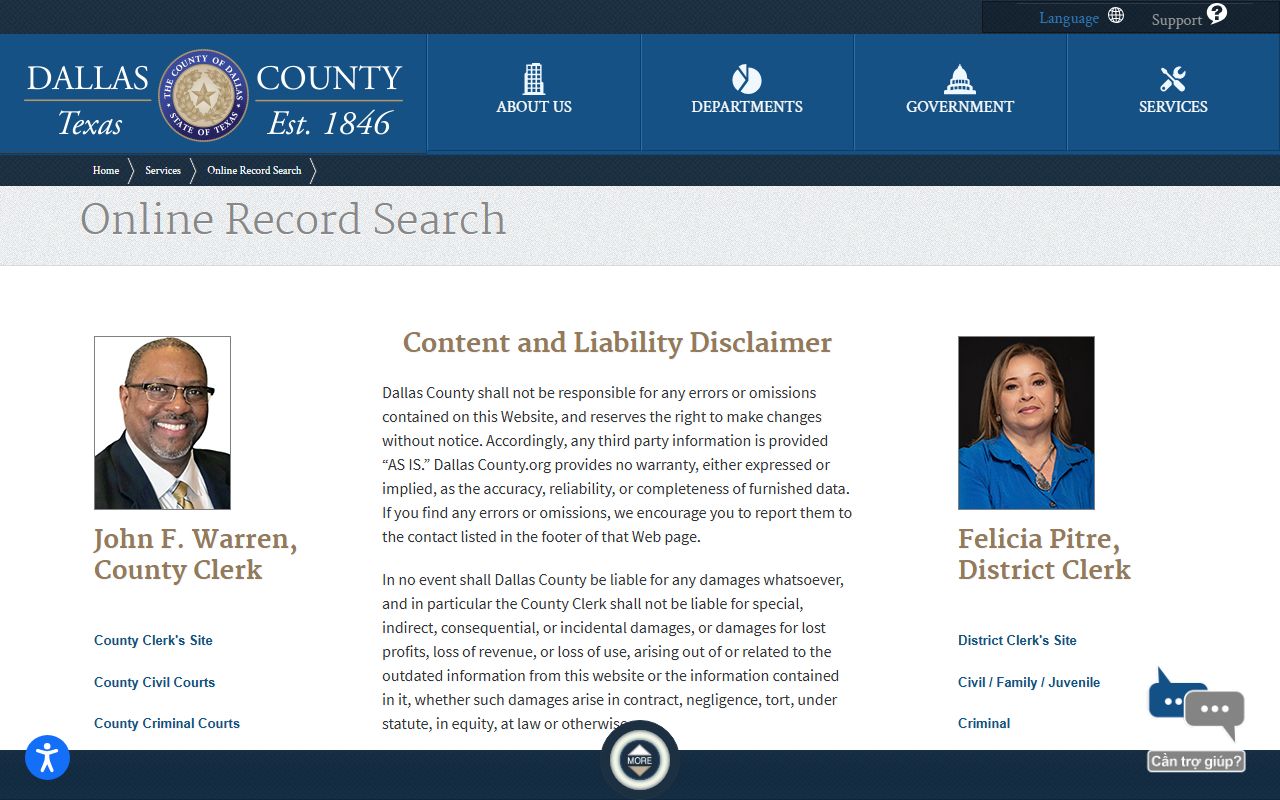
The record search portal handles non-family cases. For divorce decrees and family law records, contact the Records Office by phone, email, or in person.
The Dallas County District Clerk page provides information about the office, including filing requirements and record request procedures.
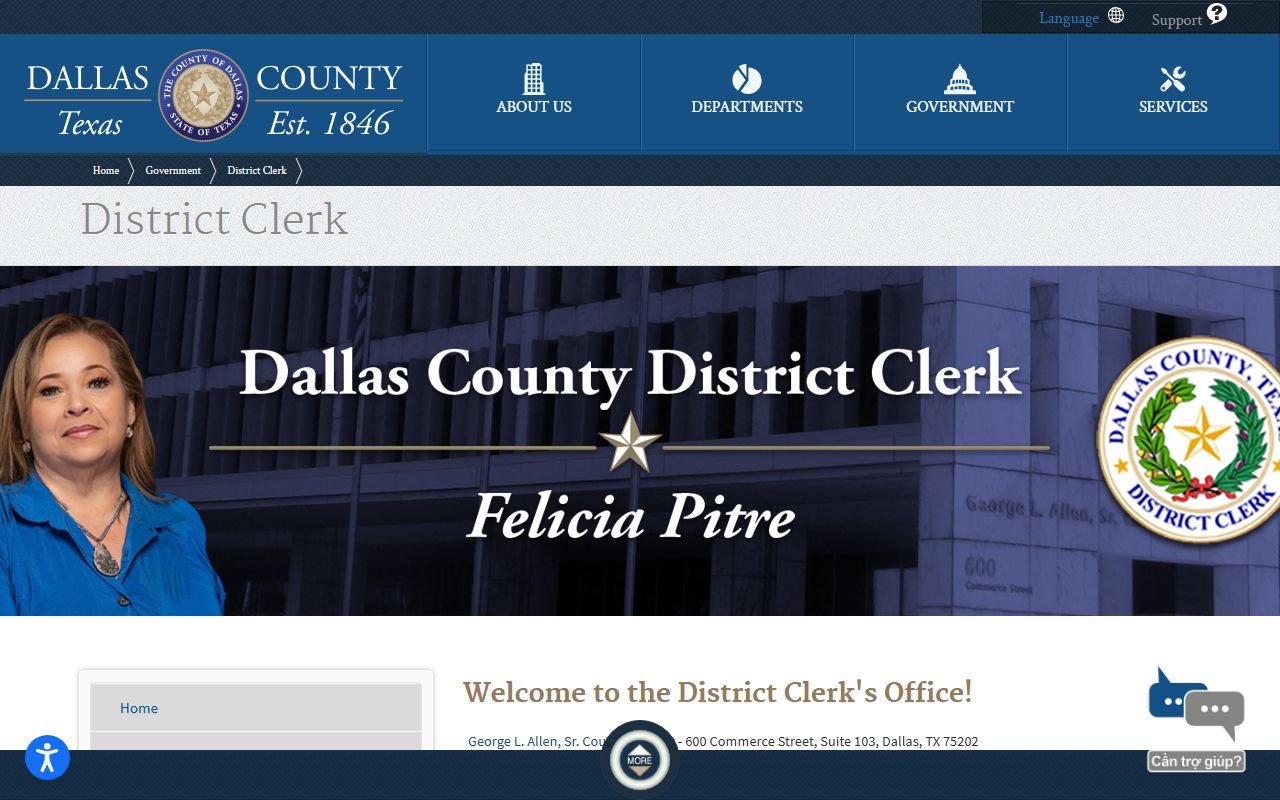
The District Clerk page explains how the office works, where to submit record requests, and how Dallas County handles divorce filings under state law.
Filing for Divorce in Dallas County
To file for divorce in Dallas County, one spouse must have lived in Texas for six months and in Dallas County for at least 90 days before filing. That rule comes from Texas Family Code Section 6.301. Dallas County covers many cities, so if you live in Dallas, Irving, Garland, Mesquite, Carrollton, or parts of Grand Prairie or Richardson, this is the right county for you. The Frank Crowley Courts Building is also used for some Dallas County court proceedings in addition to the Allen Courts Building.
You file the Original Petition for Divorce with the District Clerk at 600 Commerce Street. More detail on the divorce filing process is at dallascounty.org/government/district-clerk/filing-divorce.php. Once you file, the other spouse must be served with the petition and citation. After service, Texas requires a mandatory 60-day waiting period before any judge can finalize the divorce, as set by Texas Family Code Section 6.702. This wait can be skipped in family violence cases.
The most common ground for divorce in Texas is insupportability under Texas Family Code Section 6.001. This is a no-fault ground. It means the marriage has become impossible to continue due to conflict, with no realistic hope of reconciliation. No one needs to prove the other spouse did something wrong. Fault grounds, including cruelty under Section 6.002, adultery under Section 6.003, and others, are available but less common in uncontested cases.
For cases that move forward, both parties may be required to attend mediation before a trial. Dallas County family courts often require mediation in contested cases to try to reach agreement before using court time. If mediation fails, a judge decides the outcome at trial.
Property division follows community property law under Texas Family Code Chapter 7. The court splits marital property in a just and right manner. Separate property you had before the marriage or received by gift or inheritance stays yours if it was kept separate. Large estates and business interests often require a formal inventory and appraisement filed with the court.
60-Day Waiting Period: Texas requires at least 60 days after the petition is filed before a divorce can be granted. Even an uncontested case must wait. Plan your timeline accordingly when you file in Dallas County.
What Dallas County Divorce Records Contain
A Dallas County divorce case file held by the District Clerk includes every document filed in the proceeding. The file opens with the Original Petition for Divorce. It continues with service of process records, the other party's response if filed, any mediation agreements, temporary orders, and finally the signed Final Decree of Divorce. Financial affidavits, property inventories, and parenting plans are also in the file when applicable.
The Final Decree of Divorce is the primary document. It ends the marriage and lays out every term the court ordered. That includes who gets what property, how debts are split, child conservatorship type, the possession schedule, child support, and spousal maintenance if ordered. A name change is included in the decree if granted. Certified copies are needed for name changes with the Social Security Administration, DMV, and other agencies.
Dallas County protects the privacy of minor children in divorce records. Personal identifying information about children is not released as part of standard public access. Family court records in general are handled with more restriction than other case types. The Records Information Office can explain what it will release and what requires a specific request or court order. Financial documents attached as exhibits may also be sealed in some cases.
For a basic divorce verification, the Texas DSHS Vital Statistics Section at dshs.texas.gov/vital-statistics/marriage-divorce-verification keeps a statewide index from 1968 forward. It shows names, date, and county. For a full certified copy of the decree, contact the Dallas County District Clerk Records Office.
Dallas County District Clerk records are governed by Texas Government Code Chapter 51, which sets out the duties of district clerks and public access to court records. The Texas Public Information Act also applies to records requests, though family court records have special protections.
Legal Help for Divorce in Dallas County
Dallas County has a wide range of legal resources. The State Bar of Texas referral service is at (800) 252-9690 and at texasbar.com. Many Dallas-area family law attorneys offer consultations and handle both uncontested and contested divorce cases. The county has dozens of family law firms, so options range from solo practitioners to large firms.
For free help, Legal Aid of NorthWest Texas serves the Dallas area and handles family law cases for income-qualifying residents. Lone Star Legal Aid is another option. Both groups may be able to help with divorce, custody, and support issues. Dallas Volunteer Attorney Services also provides clinics for residents who cannot afford a lawyer. TexasLawHelp at texaslawhelp.org has free self-help guides and court forms. Supreme Court approved divorce forms are also at txcourts.gov/rules-forms.
Dallas County District Clerk records information: dallascounty.org/government/district-clerk/records-information.php. Marriage records (not divorce records) are handled by the Dallas County Clerk at dallascounty.org/government/county-clerk/vital-records/marriage-license.php.
Note: Dallas County family court records are not available online. All requests for divorce decrees and related documents must go through the Records Information Office in person, by mail, or by email at DCRecords@dallascounty.org.
Cities in Dallas County
Dallas County covers the city of Dallas and many surrounding communities. All divorce cases for residents of these cities are filed at the Dallas County District Clerk's office at 600 Commerce Street.
Other communities in Dallas County include Addison, Balch Springs, Cedar Hill, DeSoto, Duncanville, Farmers Branch, Glenn Heights, Hutchins, Lancaster, Rowlett, Sachse, Seagoville, Sunnyvale, and University Park. All of them file divorce cases at the Dallas County District Court.
Nearby Counties
Dallas County is surrounded by several other populous counties in the Dallas-Fort Worth metro area. If you are not sure which county to file in, check where you have lived for the past 90 days.