
Search Fayette County Divorce Records
Fayette County divorce records are on file with the District Clerk in La Grange. The office holds all divorce case documents, decrees, and filings for cases handled in the Fayette County district court. If you need to look up a divorce or get a certified copy of a final decree, the District Clerk is the right office to contact. Fayette County sits between Austin and Houston in South Central Texas. The District Clerk posts monthly fee reports on the county website, and case records can be requested in person or by mail through the La Grange courthouse.
Fayette County Overview
Fayette County District Clerk
The Fayette County District Clerk in La Grange keeps all court records for the district court, including divorce case files. The clerk's office stores original petitions, agreed decrees, final orders, and all documents filed during a case. Staff can search by name or cause number and provide copies of records. Certified copies of the Final Decree of Divorce are available for a fee.
The Fayette County website at co.fayette.tx.us posts the District Clerk's monthly appointments and fees. This is a sign that the office is active and processes cases regularly. The county is mid-size and handles a steady volume of family law filings each year.
La Grange is a small city, but the Fayette County courthouse handles all civil and family court matters for the area. If you need to file for divorce or request records, this is where you go. Bring a valid ID when you visit.
| Office | Fayette County District Clerk |
|---|---|
| Address |
Fayette County Courthouse 151 N. Washington Street La Grange, TX 78945 |
| Phone | (979) 968-3251 |
| Hours | Monday through Friday, 8:00 AM to 5:00 PM |
| Website | co.fayette.tx.us |
The Fayette County official website below lists county departments and public notices including District Clerk fee reports.
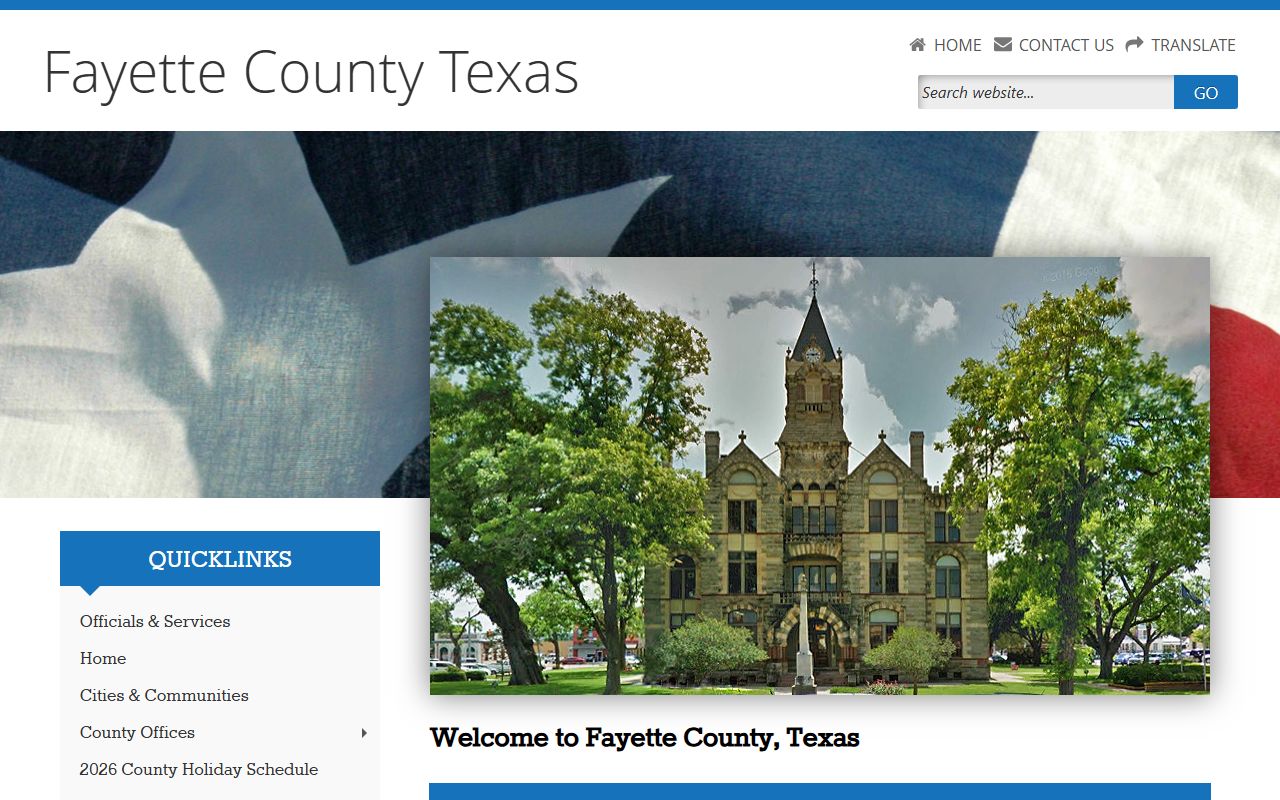
Visit co.fayette.tx.us to find the District Clerk contact info and check recent fee publications.
How to Find Divorce Records in Fayette County
You can search Fayette County divorce records through the statewide re:SearchTX portal, which covers many Texas district courts. Search by party name or cause number to see basic case info and docket entries. For full case files or certified copies, contact the District Clerk's office in La Grange.
In-person searches are handled at the courthouse. Bring both spouses' names and an approximate year the divorce was filed. A cause number helps staff find the case faster. For very old records, the file may be in storage off-site. Call ahead and allow extra time if you think the case may be from before the 1990s.
You can also request a divorce verification letter from the Texas Department of State Health Services at dshs.texas.gov/vital-statistics/marriage-divorce-verification. The state keeps a divorce index from 1968 to the present. The letter confirms a divorce was granted and in which county, but it is not a substitute for the actual decree.
Note: Certified copies carry an official seal and must be requested from the District Clerk. Plain copies work for personal records but may not be accepted by agencies that need proof of marital status.
Filing for Divorce in Fayette County
Texas law governs all divorces in Fayette County. To file in this county, one spouse must have lived in Texas for six months and in Fayette County for 90 days before filing. This rule is in Texas Family Code section 6.301. If you do not meet those residency dates, you may need to wait or file elsewhere.
Most people file on the no-fault ground of insupportability. Texas Family Code section 6.001 defines this as a marriage that has broken down due to conflict with no chance of reconciliation. You do not have to prove the other spouse did anything wrong. Fault grounds like cruelty or abandonment under Chapter 6 can still be used when relevant.
After you file the petition, Texas law requires a 60-day waiting period under Texas Family Code section 6.702. No divorce can be granted before that period ends. Family violence cases have an exception. After the wait, an agreed divorce can finish quickly. Contested cases may take longer and may require mediation or court hearings.
Tip: If both spouses agree on all terms, an uncontested divorce can often be wrapped up shortly after the 60-day waiting period passes. Court forms for uncontested cases are at txcourts.gov/rules-forms/forms.
Property in Texas marriages is divided under Texas Family Code Chapter 7. The court divides community property, meaning what was acquired during the marriage, in a way it finds just and right. Separate property each spouse owned before the marriage or received as a gift or inheritance generally stays with that person.
Contents of Fayette County Divorce Records
A divorce case file at the Fayette County District Clerk includes all court documents from the beginning to the end of the case. The Original Petition starts the file. If the case was uncontested, the Final Decree of Divorce signed by the judge closes it. Contested cases may include motions, responses, temporary orders, and a final ruling after a trial.
The Final Decree of Divorce is the key document. It shows the court's decisions on property division, debt allocation, child conservatorship, possession schedule, child support, and spousal maintenance if ordered. This is what you need for name changes, government records, and most legal matters that require proof of the divorce.
Divorce records in Fayette County are generally public. Anyone can ask for copies. Sealed documents and financial exhibits filed under seal are not open to the public. Records about minor children may also have access limits in some cases. Certified copies cost more than plain copies but carry the court's official seal.
Legal Help for Fayette County Residents
Lone Star Legal Aid covers South Central Texas and may help with family law matters for people who meet income guidelines. Call (800) 733-8394 or visit lonestarlegal.org to find out what they offer.
The State Bar of Texas has a lawyer referral line at (800) 252-9690 and an online search at texasbar.com. TexasLawHelp at texaslawhelp.org has self-help guides and approved forms. The Texas courts forms page at txcourts.gov/rules-forms/forms is free and has Supreme Court-approved divorce forms for various situations.
Cities in Fayette County
Fayette County is home to La Grange and several smaller towns. All divorce cases for county residents are filed with the District Clerk in La Grange.
Communities in Fayette County include La Grange, Schulenburg, Flatonia, Ellinger, and Muldoon. Divorce cases for all these areas are handled through the Fayette County District Court system.
Nearby Counties
Fayette County is in South Central Texas between Austin and Houston. These counties border it.