
Mills County Divorce Records
Mills County divorce records are maintained by the District Clerk in Goldthwaite, Texas. In Mills County, the District Clerk and County Clerk offices are combined and run by the same person. That means one office holds all divorce case files, marriage records, and other court documents. If you need to look up a divorce case or get a copy of a decree from this small central Texas county, this is the office to contact. Records go back to 1887 when the county was first organized. This page explains how to find Mills County divorce records and what to expect when you request them.
Mills County Overview
Mills County District and County Clerk
Sonya D. Scott serves as both District Clerk and County Clerk for Mills County. This combined role handles divorce filings, court records, land records, marriage licenses, and probate cases. The office is at 1011 Fourth Street in Goldthwaite, with a mailing address at P.O. Box 646.
Mills County was incorporated March 15, 1887, from parts of Comanche, Brown, Hamilton, and Lampasas counties. The county organized in September 1887 and held its first legal actions shortly after. Court records go back to 1887, as do marriage, divorce, probate, and land records. The current courthouse was built in 1913 after the original 1890 structure burned in May 1912. Notably, no records were lost in that fire.
The county website at co.mills.tx.us has contact information and department links. You can also reach Sonya Scott by email at sonya.scott@co.mills.tx.us for questions about records requests.
| Office | Mills County District/County Clerk - Sonya D. Scott |
|---|---|
| Mailing Address | P.O. Box 646, Goldthwaite, TX 76844 |
| Physical Address | 1011 Fourth St, Goldthwaite, TX 76844 |
| Phone | (325) 648-2711 |
| Fax | (325) 648-3251 |
| sonya.scott@co.mills.tx.us | |
| Hours | Monday through Friday, 8:00 AM to 5:00 PM |
| Website | co.mills.tx.us |
The Mills County government website provides access to department contact information and county resources.
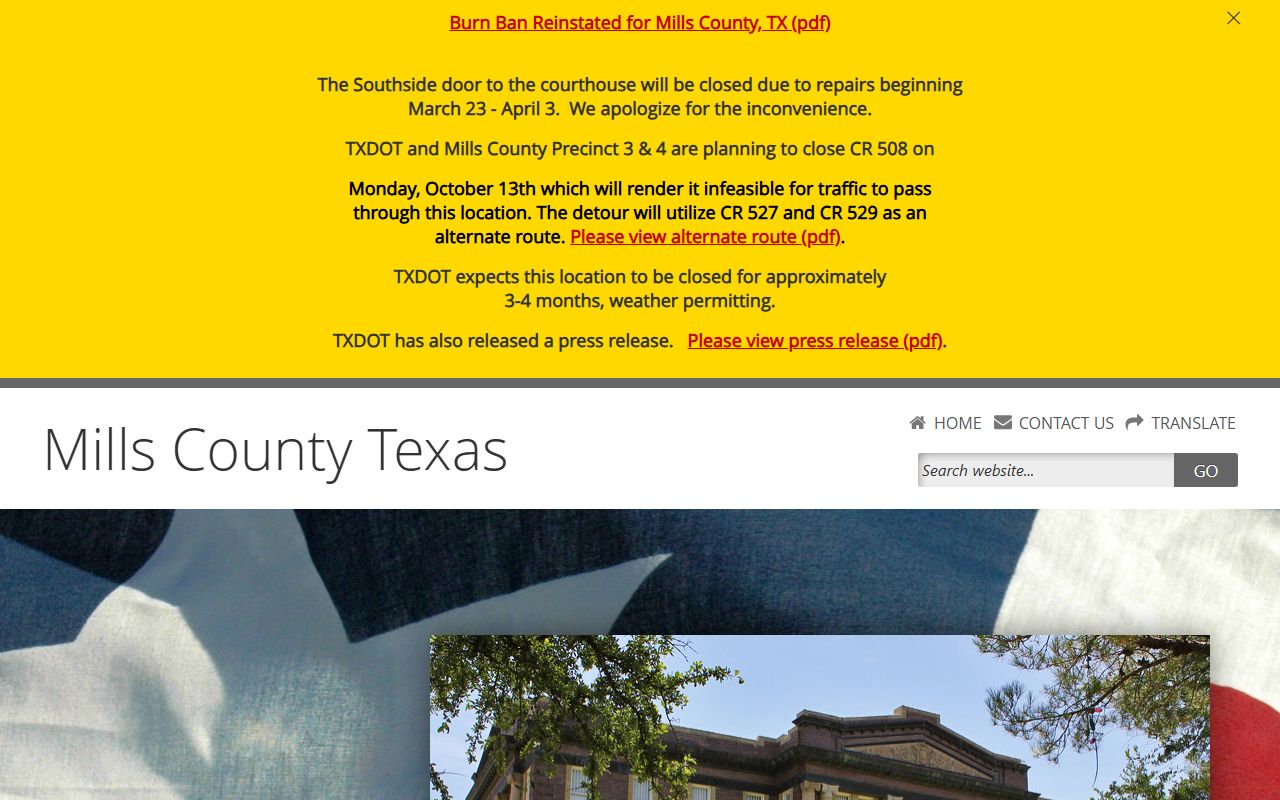
The county homepage lists the clerk's contact details and hours, which you will need when submitting a records request.
How to Find Mills County Divorce Records
Searching for divorce records in Mills County can be done in person, by mail, or through third-party online platforms for historical cases. In person is the most direct option and lets you see the full file right away.
Visit the courthouse at 1011 Fourth Street in Goldthwaite. Bring the full names of both parties and the year of the divorce. The clerk can search by name or case number. If you want copies, the fee is $1 per page. Certified documents cost $5 each. Pay by cash, check, or money order.
Mail requests go to P.O. Box 646, Goldthwaite, TX 76844. Include names, dates, case number if known, and payment. You can also email the office at sonya.scott@co.mills.tx.us to ask about availability or processing times before sending a mail request.
For online searches, TexasFile at texasfile.com covers Mills County document copies from 1999 to the present. A free account gets you basic searches. The statewide re:SearchTX portal covers many Texas courts and lets you look up case information by name or cause number at no cost. For divorces going back to 1968, a verification letter is available through Texas DSHS Vital Statistics.
Note: Mills County records date back to 1887 and are held permanently by the clerk's office. Older records may be on paper or microfilm rather than in a searchable digital system.
Divorce Filing Process in Mills County
Divorces in Mills County follow Texas state law under Texas Family Code Chapter 6. You file the Original Petition for Divorce at the courthouse on Fourth Street in Goldthwaite. That filing creates the permanent court record that the District Clerk maintains.
To file here, you must meet the residency requirement in Texas Family Code § 6.301. One spouse must have lived in Texas for six months and in Mills County for at least 90 days before filing. Check your move-in date before going to the courthouse if you haven't been in the county long.
Texas allows no-fault divorce. The most common ground is insupportability under Texas Family Code § 6.001. You say the marriage cannot continue due to conflict, with no chance of reconciliation. No fault needs to be proven. Fault grounds like cruelty, adultery, felony conviction, abandonment, and living apart are also options under sections 6.002 through 6.006.
After the petition is filed, Texas law requires 60 days before the divorce is final. This is the waiting period under Texas Family Code § 6.702. Agreed divorces can be wrapped up quickly once that wait ends and both parties have signed. Contested cases take longer. All property gained during the marriage is divided under community property rules in Texas Family Code Chapter 7.
Tip: If you are filing without an attorney in Mills County, download the approved Texas divorce forms at txcourts.gov before visiting the courthouse. Bring them filled out and ready to file.
What Mills County Divorce Records Contain
Each divorce case in Mills County produces a file that the clerk keeps permanently. The file holds the Original Petition, the other party's answer if filed, any temporary or protective orders, hearing transcripts, the settlement agreement if reached, and the Final Decree of Divorce. Financial affidavits and property inventories are also part of the record if submitted.
The Final Decree is the main document people need from a completed case. It is the signed court order that ends the marriage. It names both parties, sets out the property division, and addresses all debt responsibilities. If children are involved, the decree includes the conservatorship arrangement, possession schedule, and any child support or spousal maintenance that was ordered.
Most records in Mills County are public. Anyone can ask for a copy. Social Security numbers are redacted. Financial account numbers are not included in public copies. Records involving minor children may have limited access depending on the court's orders. Sealed records need a court order to access. The Texas Attorney General's Office at texasattorneygeneral.gov provides guidance on the Texas Public Information Act when questions arise about what records must be released.
Legal Help for Mills County Residents
Legal resources for Mills County residents cover both free legal aid and referral services that can connect you with a local attorney. The county is small, but statewide resources reach here.
Lone Star Legal Aid serves central Texas and handles family law cases at no cost for people who meet income guidelines. Call (800) 733-8394 or visit lonestarlegal.org. They can help with divorce filings, custody questions, and support matters. Heart of Texas Legal Services may also serve the area, so it's worth a call if Lone Star is at capacity.
The State Bar of Texas lawyer referral line at (800) 252-9690 can connect you with a licensed attorney for a low-cost initial consultation. Search for local lawyers at texasbar.com. Free self-help guides and divorce forms are at texaslawhelp.org and txcourts.gov. If you plan to file without an attorney, these guides walk you through the steps clearly.
Cities in Mills County
Mills County is a small, rural county in central Texas. The county seat is Goldthwaite, which is where the courthouse and District Clerk's office are located. No cities in Mills County meet the population threshold for a dedicated city page. All divorce cases from across the county are handled at the Goldthwaite courthouse.
Nearby Counties
These counties border Mills County. File in the county where you have lived for at least 90 days before filing for divorce.